
Small-sided game exercises for U10 players
Small-sided games (SSGs) are one of the most powerful tools in modern football methodology. For U10 players (9-10 years), they multiply ball contacts, improve decision-making in reduced spaces and create realistic game-like scenarios that develop both technical and tactical skills simultaneously. In this article you will find 5 small-sided game exercises for U10 players, with complete structure: objective, players, materials, space, duration and variation. Everything you need to use SSGs effectively at this age.
Why work on small-sided games with U10 players?
Small-sided games are the most complete methodological tool in modern training. For U10 players (9-10 years), these exercises simultaneously develop ball contact frequency, decision-making in reduced spaces and the cognitive understanding of offensive and defensive principles. Three pedagogical principles to keep in mind when using SSGs with U10 players. First, space per player: adjust the space to the objective. Second, jokers: use jokers to create numerical superiority and increase possession time for the attacking team. Third, progression: from possession rondos to application games with specific objectives like progressing to a second zone or finishing in mini-goals. These exercises range from possession-based rondos to application games with progression objectives.
Exercises 5
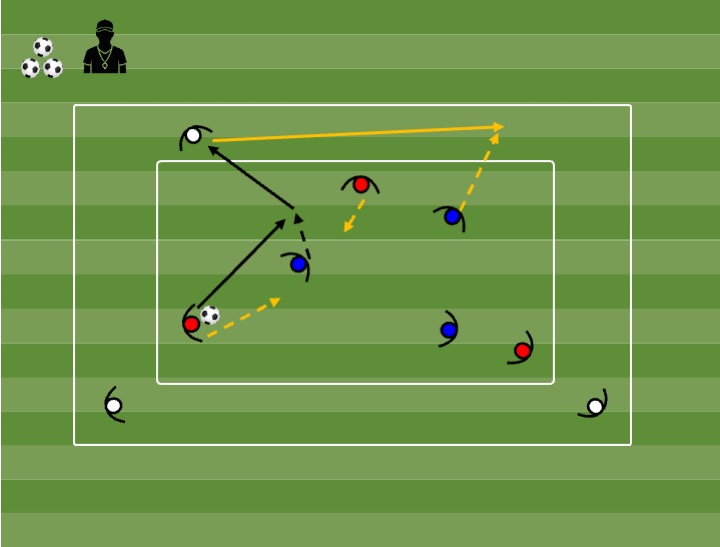
Possession 3+3v3 (nested rectangles)
| Objective | Maintain possession, improve body positioning, control, passing and offensive relationships. Win the ball back through pressing |
| Players | 9-20 players (3 teams of 3). Can run 2 simultaneous tasks |
| Materials | Cones, discs, 3 sets of bibs and balls |
| Space | 2 rectangles one inside the other: inner 6-12 m per side, outer 12-18 m per side |
| Duration | 3-4 sets x 3-5 min per set |
| Category | Small-sided possession |
A 6v3 possession game is played in a nested rectangle space. The objective for the attacking teams (red and blue) is to maintain possession through passes, constant movement and forming association triangles.
The objective for the defending team (white) is to win the ball back through interception and tackle. When the white team recovers the ball, they join possession with the team that did not lose it (3+3) and the team that lost the ball (3) becomes the new defenders.
Attack: focus on pass execution, offering passing lines to the ball-carrier and maintaining width in attack. Defence: close passing lanes to press and reduce space.
Variation: reduce the space to increase defensive intensity or add a touch limit to force faster play. You can also add a joker to create numerical superiority and facilitate learning.
Want a full session with these drills? FutCoach generates it in seconds.
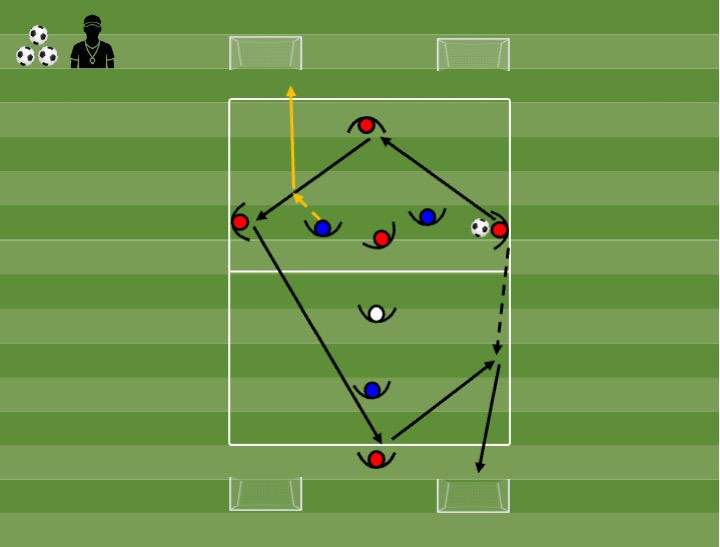
Try FutCoach freeApplication 5v3 + 1 joker
| Objective | Progress in attack, improve body positioning, control, passing, third-man runs and offensive relationships |
| Players | 9-20 players split into 2 teams: 5 red attackers, 3 blue defenders and 1 white joker |
| Materials | Cones, discs, bibs and balls |
| Space | 1 rectangle divided into 2 squares of 12-15 m per side |
| Duration | 3-4 sets x 3-5 min per set |
| Category | Small-sided application |
An application game with 2 spaces is played in which the attacking team (red) must connect with an interior player to progress; they can use the red player in the adjacent space and the white joker who always plays with the team in possession.
If the attacking team loses the ball they try to recover it immediately through pressing after loss.
Attack: speed of circulation, pass execution, offering passing lines to the ball-carrier, width in attack. Defence: prevent the opponent's progression, close passing lanes to press and reduce space.
Variation: reduce the space to increase defensive intensity or add a touch limit to force faster play. You can also add a joker to create numerical superiority and facilitate learning.
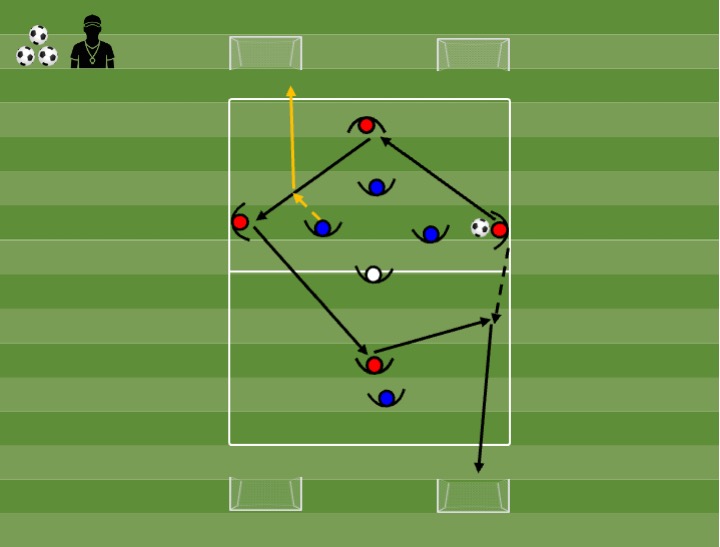
Application 4v4 + 1 joker
| Objective | Progress in attack, improve body positioning, control, passing, third-man runs and offensive relationships |
| Players | 9-20 players split into 2 teams: 4 red attackers, 4 blue defenders and 1 white joker |
| Materials | Cones, discs, bibs and balls |
| Space | 1 rectangle divided into 2 squares of 15-25 m per side |
| Duration | 3-4 sets x 3-5 min per set |
| Category | Small-sided application |
An application game with 2 spaces is played in which the attacking team (red) must connect with an interior player to progress; they can use the red player in the adjacent space and the white joker who always plays with the team in possession.
If the attacking team loses the ball they try to recover it immediately through pressing after loss.
Attack: speed of circulation, pass execution, offering passing lines to the ball-carrier, width in attack. Defence: prevent the opponent's progression, close passing lanes to press and reduce space.
Variation: reduce the space to increase defensive intensity or add a touch limit to force faster play. You can also add a joker to create numerical superiority and facilitate learning.
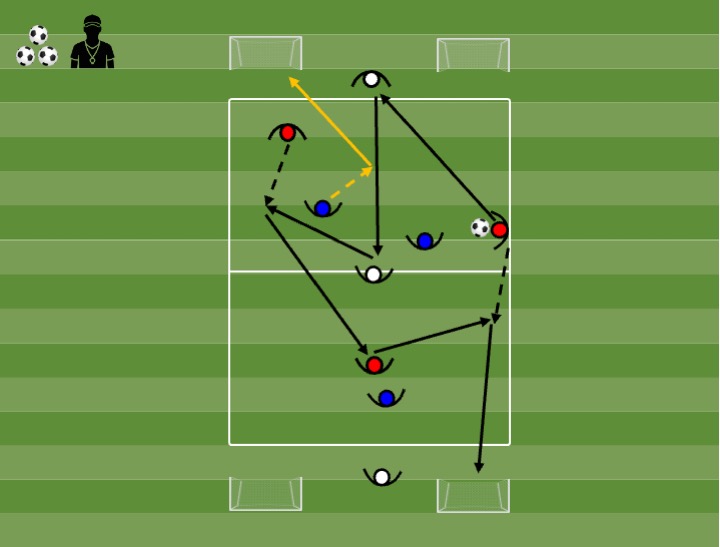
Application 3v3 + 3 jokers
| Objective | Progress in attack, improve body positioning, control, passing, third-man runs and offensive relationships |
| Players | 9-20 players split into 3 teams: 3 red attackers, 3 blue defenders and 3 white jokers |
| Materials | Cones, discs, bibs and balls |
| Space | 1 rectangle divided into 2 squares of 12-15 m per side |
| Duration | 3-4 sets x 3-5 min per set |
| Category | Small-sided application |
An application game with 2 spaces is played in which the attacking team (red) must complete 4 passes or execute a third-man combination in order to progress to the 2nd space and finish in the mini-goals; they can use the white jokers who always play with the team in possession.
If the attacking team loses the ball they try to recover it immediately through pressing after loss.
Attack: speed of circulation, pass execution, offering passing lines to the ball-carrier, width in attack. Defence: prevent the opponent's progression, close passing lanes to press and reduce space.
Variation: reduce the space to increase defensive intensity or add a touch limit to force faster play. You can also add a joker to create numerical superiority and facilitate learning.
Application 3v3 + 3 jokers
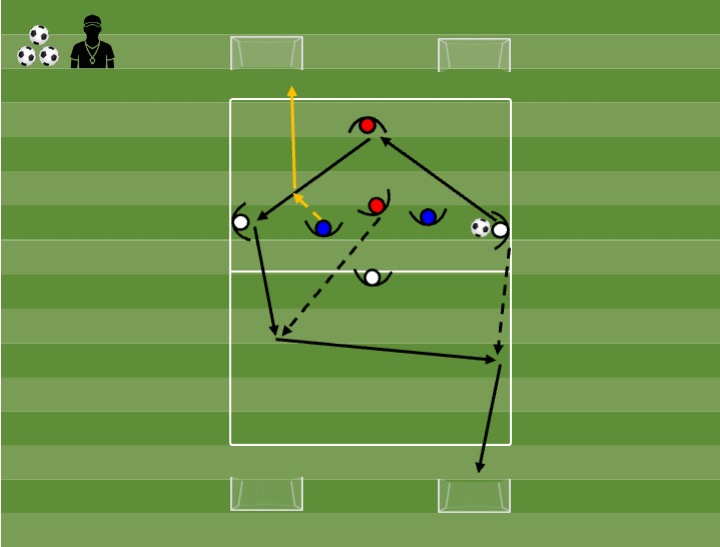
| Objective | Progress in attack, make switch combinations, improve body positioning, control, passing, third-man runs and offensive relationships |
| Players | 9-20 players split into 3 teams: 3 red attackers, 3 blue defenders and 3 white jokers |
| Materials | Cones, discs, bibs and balls |
| Space | 1 rectangle divided into 2 squares of 12-15 m per side |
| Duration | 3-4 sets x 3-5 min per set |
| Category | Small-sided application |
An application game with 2 spaces is played in which the attacking team (red) must complete a wing-to-wing switch by playing a pass with both white jokers in order to progress to the 2nd space and finish in the mini-goals.
If the attacking team loses the ball they try to recover it immediately through pressing after loss.
Attack: speed of circulation, pass execution, offering passing lines to the ball-carrier, width in attack. Defence: prevent the opponent's progression, close passing lanes to press and reduce space.
Variation: reduce the space to increase defensive intensity or add a touch limit to force faster play. You can also add a joker to create numerical superiority and facilitate learning.
Build your full session with FutCoach
FutCoach generates complete training sessions for U10 players in seconds. Select your age group, the session objective (small-sided games) and the number of players, and the AI creates a complete session for you with warm-up, main block and cool-down. Download FutCoach free and prepare your next small-sided games session in less than 2 minutes. No blank templates, no improvising on the field.
Frequently asked questions
What is the ideal space size for small-sided games with U10 players?
The space depends on the exercise objective and number of players. As a general rule, between 6 and 12 m² per player favours technical and tactical work. Adjust the space according to what you want to develop in your players.
Why use jokers in small-sided games?
Jokers (players who always play with the team that has the ball) create numerical superiority for the possessing team, giving more time and space to practice the target skill. They also keep all players active and involved throughout the exercise.
How many repetitions should I do in small-sided games?
"The ideal for U10 players is sets of 3-8 minutes with 1-2 minutes rest between sets. The number of sets depends on where the exercise sits in the session — 3-4 sets in the main block, 1-2 in warm-up or cool-down."
Related articles
Small-sided game exercises for U8 players
Small-sided games (SSGs) are one of the most powerful tools in modern football methodology. For U8 players (6-8 years), they multi...
Small-sided game exercises for U12 players
Small-sided games (SSGs) are one of the most powerful tools in modern football methodology. For U12 players (11-12 years), SSGs de...
Small-sided game exercises for U14 players
Small-sided games (SSGs) are one of the most powerful tools in modern football methodology. For U14 players (13-14 years), SSGs de...