
Possession and rondo exercises for U10 players
Keeping the ball with purpose is one of the hardest skills to develop at the initiation-development stage. For U10 players (9-10 years), rondos and possession exercises are the perfect tool to work on body positioning, oriented control and decision-making in reduced spaces, without the pressure of the result. In this article you will find 5 possession and rondo exercises for U10 players, with complete structure: objective, players, materials, space, duration and progression. Perfect for the warm-up, tactical block or as a standalone activity.
Why work on possession and rondo with U10 players?
Rondos and possession exercises are the coach's great allies for developing game intelligence. At U10 (9-10 years), these tasks simultaneously work on body positioning, oriented control, first-touch passing and pressing without the ball, all in a format that players love. Three pedagogical principles to bear in mind when working on possession with U10 players. First, the quality of the control determines the quality of the pass: every control must prepare the next action. Second, the organised pressing of the defenders is just as important as the circulation by those with the ball. Third, possession must have an objective (progress, switch play, find the interior pass) to avoid becoming an empty circuit. The exercises in this article range from basic rondos to possession situations with numerical superiority and goals.
Exercises 5
Rondo 3v1
| Objective | Maintain possession, improve body positioning, control, passing and offensive relationships. Win the ball back through pressing |
| Players | 4-20 players (3 attackers vs 1 defender) |
| Materials | Cones, discs, bibs and balls |
| Space | One square of 6-8 m per side |
| Duration | 4-6 sets x 2-4 min per set |
| Category | Rondo |
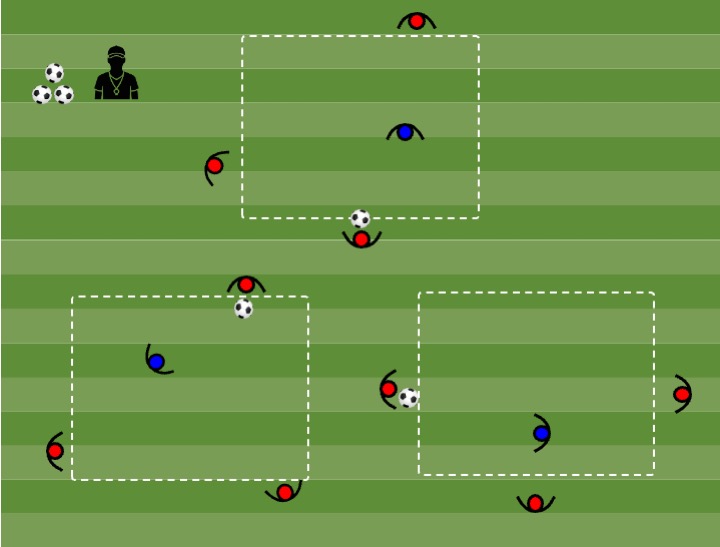
The objective for the attacking team (red) is to maintain possession through passes, constant movement and association triangles.
The objective for the blue defender is to win the ball back through interception and tackle. Attackers move freely along the sides of the square.
Focus on the pass execution and offering passing lines to the ball-carrier.
Variation: reduce the space to increase defensive intensity or add a touch limit to force faster play. You can also add a joker to create numerical superiority and facilitate learning.
Want a full session with these drills? FutCoach generates it in seconds.
Try FutCoach freeRondo 5v2
| Objective | Maintain possession, improve body positioning, control, passing and offensive relationships. Win the ball back through pressing |
| Players | 7-21 players (5 attackers vs 2 defenders) |
| Materials | Cones, discs, bibs and balls |
| Space | One square of 6-8 m per side |
| Duration | 4-6 sets x 2-4 min per set |
| Category | Rondo |
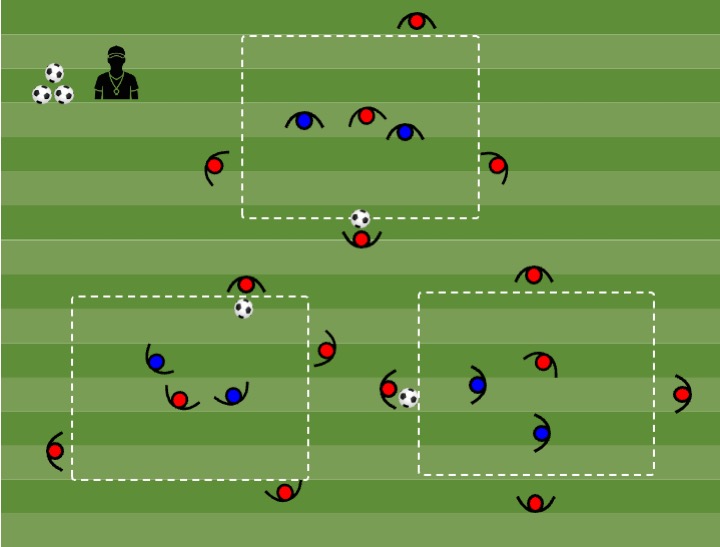
The objective for the attacking team (red) is to maintain possession through passes, constant movement and association triangles.
The objective for the defending team (blue) is to win the ball back through interception and tackle. One attacking player is positioned in the centre of the square.
Attack: focus on the pass execution and offering passing lines to the ball-carrier. Defense: direct the pressure and close the interior pass.
Variation: reduce the space to increase defensive intensity or add a touch limit to force faster play. You can also add a joker to create numerical superiority and facilitate learning.
Rondo 4+1 joker vs 2
| Objective | Maintain possession, improve body positioning, control, passing and offensive relationships. Win the ball back through pressing |
| Players | 7-21 players (4 attackers + 1 joker vs 2 defenders) |
| Materials | Cones, discs, bibs and balls |
| Space | One square of 6-8 m per side |
| Duration | 4-6 sets x 2-4 min per set |
| Category | Rondo |
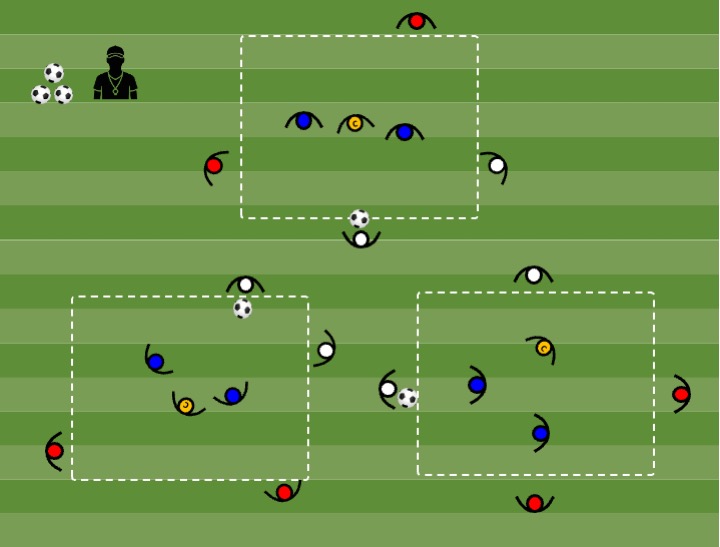
The objective for the attacking team (red) is to maintain possession through passes, constant movement and association triangles.
The objective for the defending team (blue) is to win the ball back through interception and tackle. The joker is positioned in the centre of the square.
Attack: focus on the pass execution and offering passing lines to the ball-carrier. Defense: direct the pressure and close the interior pass.
Variation: reduce the space to increase defensive intensity or add a touch limit to force faster play. You can also add a joker to create numerical superiority and facilitate learning.
Rondo 6v2 (2 spaces)
| Objective | Progress in attack, maintain possession, improve body positioning, control, passing and offensive relationships |
| Players | 8-24 players (6 attackers vs 2 defenders) |
| Materials | Cones, discs, bibs and balls |
| Space | 1 rectangle divided into 2 squares of 6-9 m per side |
| Duration | 3-6 sets x 2-4 min per set |
| Category | Rondo |
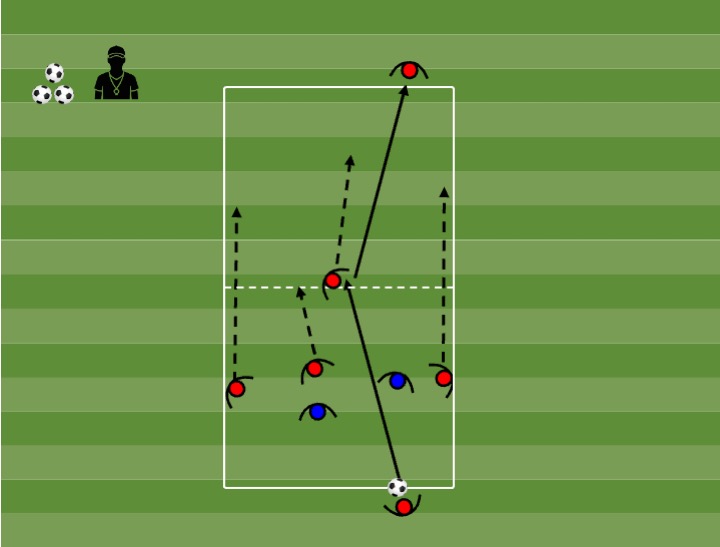
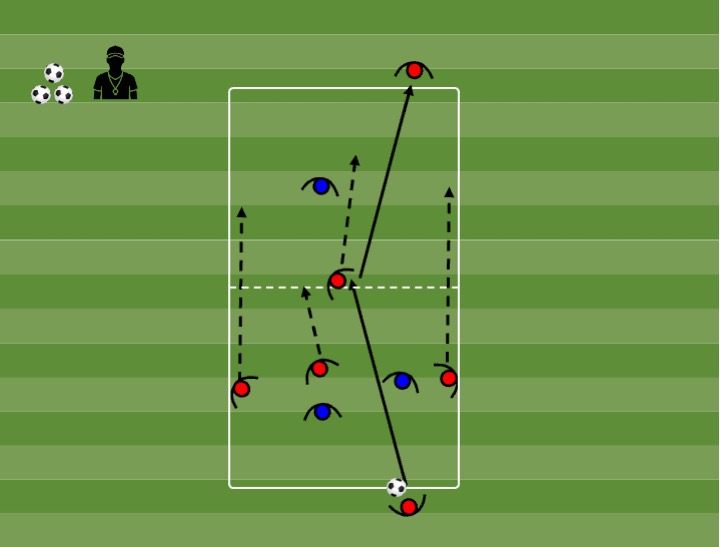
A rondo with 2 spaces is played where the attacking team (red) must complete 4 passes before progressing via a pass to the red player in the other square, maintaining constant movement and forming association triangles. After the pass the red players move to the other square.
The objective for the defending team (blue) is to win the ball back through interception and tackle.
Attack: focus on pass execution, body positioning to progress and offering passing lines to the ball-carrier. Defense: direct the pressure and close the interior pass.
Variation: reduce the space to increase defensive intensity or add a touch limit to force faster play. You can also add a joker to create numerical superiority and facilitate learning.
Rondo 6v3 (2 spaces)
| Objective | Progress in attack, maintain possession, improve body positioning, control, passing and offensive relationships |
| Players | 9-20 players (6 attackers vs 3 defenders) |
| Materials | Cones, discs, bibs and balls |
| Space | 1 rectangle divided into 2 squares of 6-9 m per side |
| Duration | 3-6 sets x 2-4 min per set |
| Category | Rondo |
A rondo with 2 spaces is played where the attacking team (red) must complete 4 passes before progressing via a pass to the red player in the other square, maintaining constant movement and forming association triangles. After the pass the red players move to the other square.
The objective for the defending team (blue) is to win the ball back through interception and tackle.
Attack: focus on pass execution, body positioning to progress and offering passing lines to the ball-carrier. Defense: direct the pressure and close the interior pass.
Variation: reduce the space to increase defensive intensity or add a touch limit to force faster play. You can also add a joker to create numerical superiority and facilitate learning.
Build your full session with FutCoach
FutCoach generates complete training sessions for U10 players in seconds. Select your age group, the session objective (possession / rondo) and the number of players, and the AI creates a complete session for you with warm-up, main block and cool-down. Download FutCoach free and prepare your next possession / rondo session in less than 2 minutes. No blank templates, no improvising on the field.
Frequently asked questions
How many players do I need for a rondo with U10 players?
The most basic rondo (3v1 or 4v1) needs just 4-5 players, which makes it ideal for small groups or for warming up while the last players arrive. More complex rondos (6v2, 8v2) need more players and lend themselves to working on switches of play and the interior pass.
Is the rondo only for warming up or does it have real tactical value?
The rondo has enormous tactical value. It simultaneously works on body positioning, oriented control, first-touch passing, pressing without the ball, communication and defensive transition. At U10 it can be used in the warm-up, as the central task of a technical-tactical session or as an activation exercise in the cool-down.
How many touches should I allow in possession exercises with U10 players?
"For U10 (9-10 years), starting without a touch limit and then gradually restricting (maximum 3, then 2) is the best progression. Limited touches increase cognitive and physical intensity, but must be introduced when the player already masters the basic technical gesture. If restricted too early, the difficulty exceeds the level and the exercise loses quality."
Related articles
Possession and rondo exercises for U8 players
Keeping the ball with purpose is one of the hardest skills to develop at the initiation stage. For U8 players (6-8 years), rondos ...
Possession and rondo exercises for U12 players
Keeping the ball with purpose is one of the hardest skills to develop at the development stage. For U12 players (11-12 years), ron...
Possession and rondo exercises for U14 players
Keeping the ball with purpose is one of the hardest skills to develop at the advanced formation stage. For U14 players (13-14 year...