
Offensive transition exercises for U16 players
The moment a team wins the ball is one of the most decisive in football. Teaching U16 players (15-16 years) to react quickly and intelligently when transitioning from defence to attack is a skill that, when mastered, becomes a decisive weapon in competitive matches. In this article you will find 5 offensive transition drills for U16 players, with objective, materials, space, duration and a variation for each one. Exercises that teach your players what to do in those crucial seconds after winning the ball.
Why work on offensive transition with U16 players?
The defensive-to-offensive transition is the moment when the team recovers the ball and switches to attack. In that instant, the opponent is disorganised and the space is open — that is exactly when the most dangerous attacks begin. From a pedagogical standpoint, working on transition with U16 players (15-16 years) requires three key principles. First, immediate reaction: the player who wins the ball must act fast, either advancing or finding the safe pass. Second, support: teammates must offer passing lines immediately and occupy the space. Third, ball progression: the goal is always to advance towards the opponent's goal as quickly as possible, but without losing the ball. These exercises work on these principles through complex positional evolutions, bilateral wide channel attacks and multi-variant transition circuits that replicate match-realistic scenarios.
Exercises 5
Offensive evolution — from goalkeeper (3 variants) + finishing
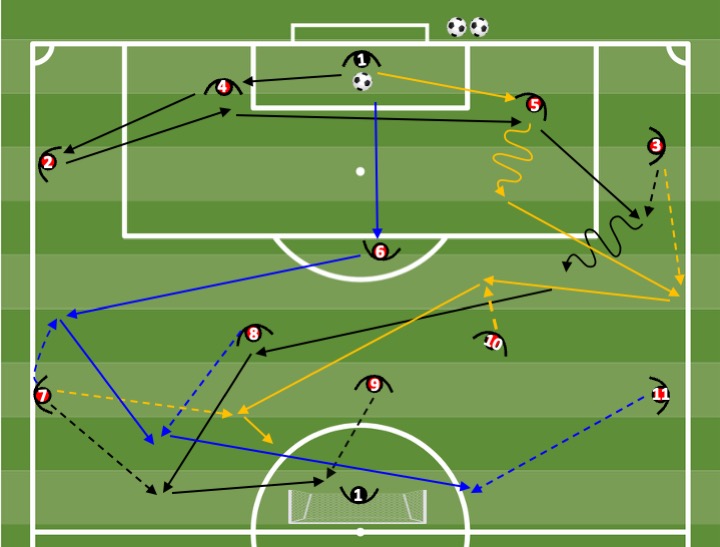
| Objective | Initiate attack from goalkeeper, progress in attack, finish at goal |
| Players | 10-20 players + 2 goalkeepers |
| Materials | Balls |
| Space | Half pitch to full pitch |
| Duration | 2-4 sets x 4-6 minutes |
| Category | Evolution drill |
A passing circuit in specific positions where ball circulations starting from the goalkeeper lead to finishing. Three sequences (BLACK, ORANGE, BLUE) are performed consecutively.
Performed in the order BLACK-ORANGE-BLUE for time with rotation after each set.
Focus on ball control, pass execution, circulation speed and timing of runs and finishing.
Variation: reduce the space to increase defensive intensity or add a touch limit to force faster play. You can also add a joker to create numerical superiority and facilitate learning.
Want a full session with these drills? FutCoach generates it in seconds.
Try FutCoach freeOffensive evolution — wide channel attack + finishing (2 variants)
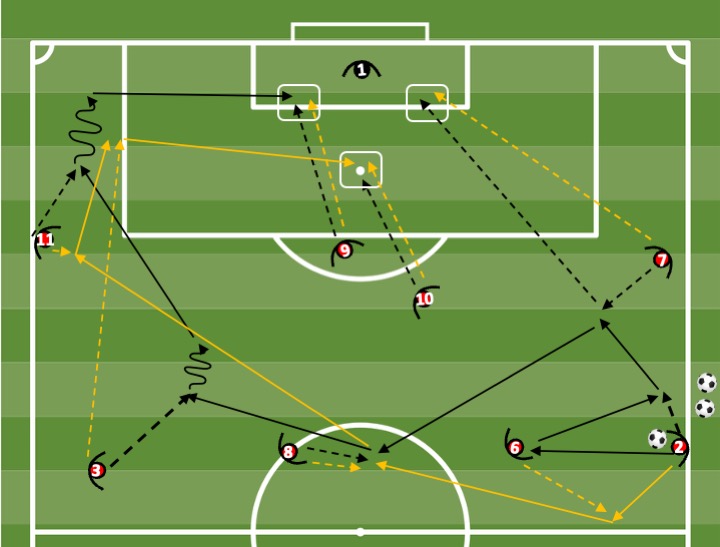
| Objective | Progress through wide channel, finish attack with various solutions |
| Players | 8-20 players + 1-2 goalkeepers |
| Materials | Balls |
| Space | Half pitch to full pitch |
| Duration | 2-4 sets x 4-6 minutes |
| Category | Evolution drill |
A passing circuit in specific positions where ball circulations progress through the wide channel and lead to finishing. Two sequences (BLACK and ORANGE) are performed consecutively.
Performed in the order BLACK-ORANGE for time with rotation after each set.
Focus on ball control, pass execution, circulation speed and timing of runs and finishing.
Variation: reduce the space to increase defensive intensity or add a touch limit to force faster play. You can also add a joker to create numerical superiority and facilitate learning.
Offensive evolution — central + wide channels + finishing (4 variants)
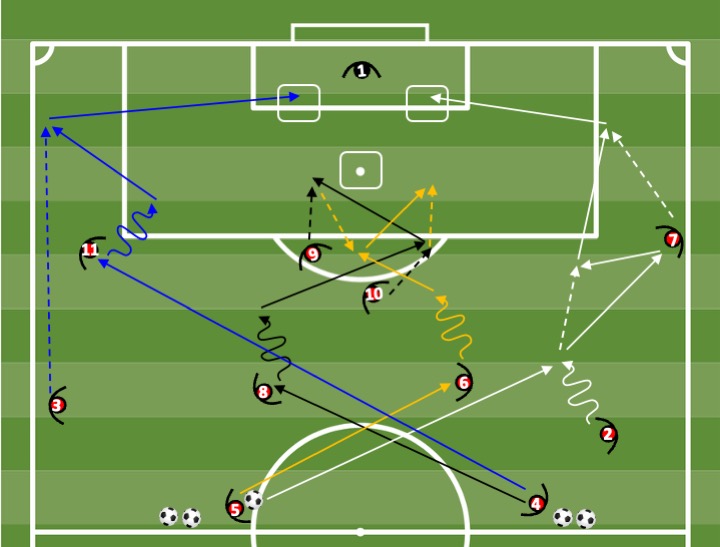
| Objective | Progress through central and wide channels, finish attack |
| Players | 10-20 players + 1-2 goalkeepers |
| Materials | Balls |
| Space | Half pitch to full pitch |
| Duration | 2-4 sets x 4-6 minutes |
| Category | Evolution drill |
A passing circuit in specific positions where ball circulations progress through central and wide channels leading to finishing. Four sequences (BLACK, ORANGE, WHITE, BLUE) are performed consecutively.
Performed in the order BLACK-ORANGE-WHITE-BLUE for time.
Focus on ball control, pass execution, circulation speed and timing of runs and finishing.
Variation: reduce the space to increase defensive intensity or add a touch limit to force faster play. You can also add a joker to create numerical superiority and facilitate learning.
Offensive evolution — bilateral central + wide + finishing (4 variants)
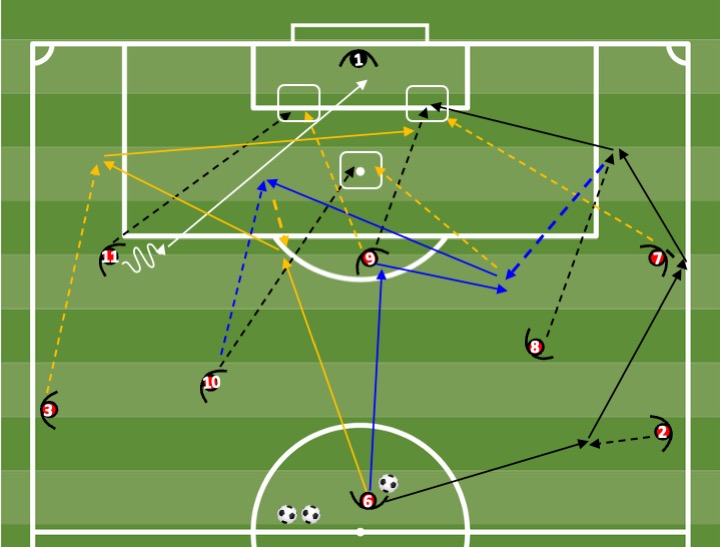
| Objective | Progress through central and wide channels, finish attack (bilateral) |
| Players | 8-20 players + 1-2 goalkeepers |
| Materials | Balls |
| Space | Half pitch to full pitch |
| Duration | 2-4 sets x 4-6 minutes |
| Category | Evolution drill |
A passing circuit in specific positions where ball circulations progress through central and wide channels leading to finishing. Four sequences (WHITE, BLACK, BLUE, ORANGE) are performed consecutively.
Performed in the order WHITE-BLACK-BLUE-ORANGE for time, covering both right and left profiles.
Focus on ball control, pass execution, circulation speed and timing of runs and finishing.
Variation: reduce the space to increase defensive intensity or add a touch limit to force faster play. You can also add a joker to create numerical superiority and facilitate learning.
Offensive evolution — wide channel attack + finishing (2 variants, bilateral)
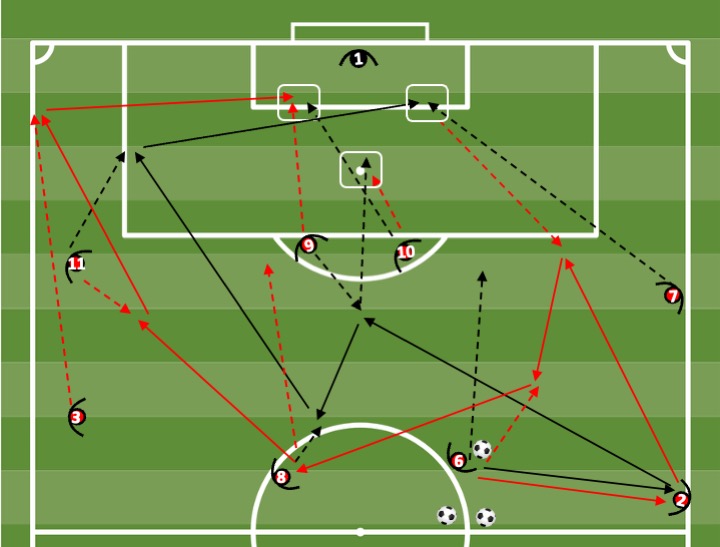
| Objective | Progress from wide channel, finish attack with various solutions (bilateral) |
| Players | 8-20 players + 1-2 goalkeepers |
| Materials | Balls |
| Space | Half pitch to full pitch |
| Duration | 2-4 sets x 4-6 minutes |
| Category | Evolution drill |
A passing circuit in specific positions where ball circulations progress from the wide channel leading to finishing. Two sequences (BLACK and RED) are performed consecutively.
Performed in the order BLACK-RED for time with rotation after each set, covering both profiles.
Focus on ball control, pass execution, circulation speed and timing of runs and finishing.
Variation: reduce the space to increase defensive intensity or add a touch limit to force faster play. You can also add a joker to create numerical superiority and facilitate learning.
Build your full session with FutCoach
FutCoach generates complete training sessions for U16 players in seconds. Select your age group, the session objective (offensive transition) and the number of players, and the AI creates a complete session for you with warm-up, main block and cool-down. Download FutCoach free and prepare your next offensive transition session in less than 2 minutes. No blank templates, no improvising on the field.
Frequently asked questions
From what age does it make sense to work on offensive transition?
At U16 (15-16 years) the offensive transition should already be a fully systematised aspect of the team's game model. Players should be able to read the game and distinguish between transitioning with vertical pace (counter-attack) and building up patiently depending on the position of the opponent's defence.
How long does an offensive transition last in a real match?
The most effective transitions last between 3 and 8 seconds. After that time the opponent reorganises and the advantage is lost. That is why in training it is essential to work on the speed of reaction and decision-making immediately after winning the ball.
What is the difference between offensive transition and counter-attack?
"The offensive transition is any moment in which the team switches from defending to attacking, regardless of the speed. The counter-attack is a specific type of transition characterised by its speed and verticality. At U16, players should master both concepts and execute them instinctively based on the game situation."
Related articles
Offensive transition exercises for U8 players
The moment a team wins the ball is one of the most decisive in football. Teaching U8 players (6-8 years) to react quickly and inte...
Offensive transition exercises for U10 players
The moment a team wins the ball is one of the most decisive in football. Teaching U10 players (9-10 years) to react quickly and in...
Offensive transition exercises for U12 players
The moment a team wins the ball is one of the most decisive in football. Teaching U12 players (11-12 years) to react quickly and i...