
High pressure exercises for U16 players
Planning high pressure exercises for U16 players can be a real headache. At this age (15-16 years), players are learning to understand collective play, and asking them to press with purpose requires very specific methodology. Just shouting "press!" from the sideline is never enough. In this article you will find 5 high pressure drills designed for U16 players, with a clear objective, number of players, required materials, recommended space, estimated duration and how to progress or simplify each task. Everything you need to work on pressing effectively with your team.
Why work on high pressure with U16 players?
U16 teams are at an advanced developmental stage where high press can be implemented as a sophisticated tactical system. At this age, players can coordinate pressing traps, cover shadows and counter-press with purpose. From a pedagogical standpoint, there are three fundamental principles when working on high pressure with U16 players. First, pressure must arise from a clear stimulus: a back pass, a poor touch by the opponent, a signal from the coach. Second, the nearest player presses while teammates close down space — this is worked on through repetition in controlled situations. Third, organization after failing to recover the ball is just as important as the pressing itself. These exercises are designed to work on these principles progressively, from reduced situations with few variables to more complex application contexts.
Exercises 5
Application 4v4 + 1 joker (advanced)
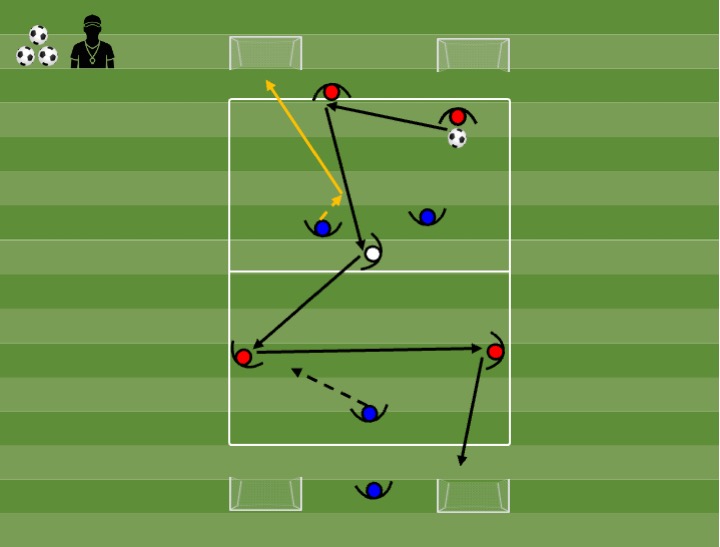
| Objective | Progress in attack; improve body positioning, control, passing, third-man combinations and offensive relationships. Improve defensive pressing ability |
| Players | 9-20 players: 4 red attackers, 4 blue defenders and 1 white joker |
| Materials | Cones, discs, bibs and balls |
| Space | 1 rectangle divided into 2 squares of 15-25 m per side |
| Duration | 3-4 sets x 3-5 min per set |
| Category | Small-sided application |
An application game with 2 spaces where the attacking team (red) must progress to space 2 via a pass to players in that space before finishing at mini-goals. Players must position at different lines and heights using third-man combinations, constant movement and triangles.
Attackers are positioned 2 in each square with the joker providing numerical advantage. Defenders are positioned 1+2 as per diagram, always remaining numerically disadvantaged.
Attack: speed of circulation, passing quality, offering passing lines, width. Defense: prevent opponent progression, close passing lanes, direct the pressure.
Variation: reduce the space to increase defensive intensity or add a touch limit to force faster play. You can also add a joker to create numerical superiority and facilitate learning.
Want a full session with these drills? FutCoach generates it in seconds.
Try FutCoach freeRondo 6v3
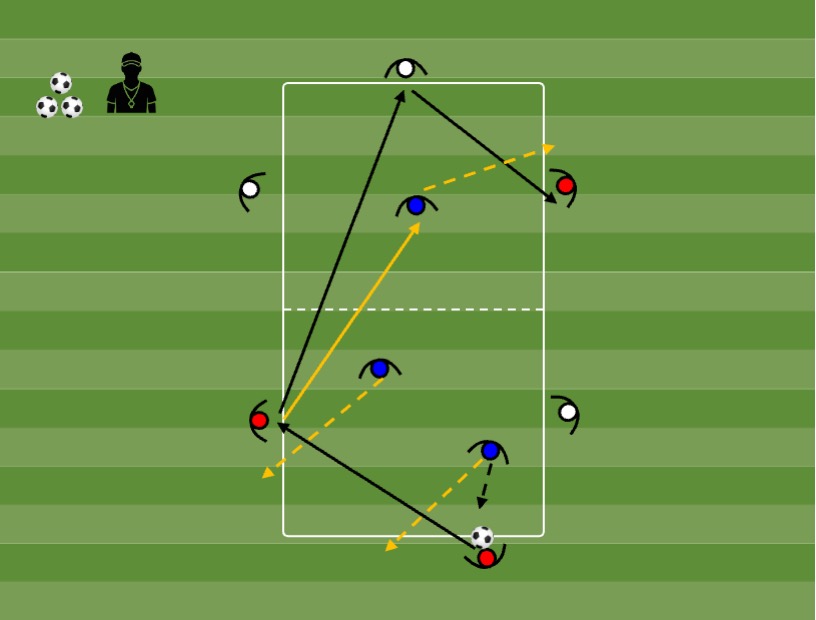
| Objective | Offensive transition: find the safe pass after winning the ball. Defensive transition: press immediately after losing the ball |
| Players | 9-18 players (3 teams of 3) |
| Materials | Cones, bibs and balls |
| Space | 20x30m |
| Duration | 3-5 sets x 3-4 min per set |
| Category | Rondo |
A rondo with 2 spaces is played where the ball-possessing team (2 groups of 3) must maintain possession through passes, constant movement and association triangles, then progress via a pass to the players waiting in the other square.
The objective for the defending team is to recover the ball through interception or tackle, make a safe pass and take up the positions vacated by the team that lost the ball.
Offensive transition: find the safe pass. Defensive transition: focus on pressing immediately after losing the ball.
Variation: reduce the space to increase defensive intensity or add a touch limit to force faster play. You can also add a joker to create numerical superiority and facilitate learning.
Rondo 6+1 joker vs 3
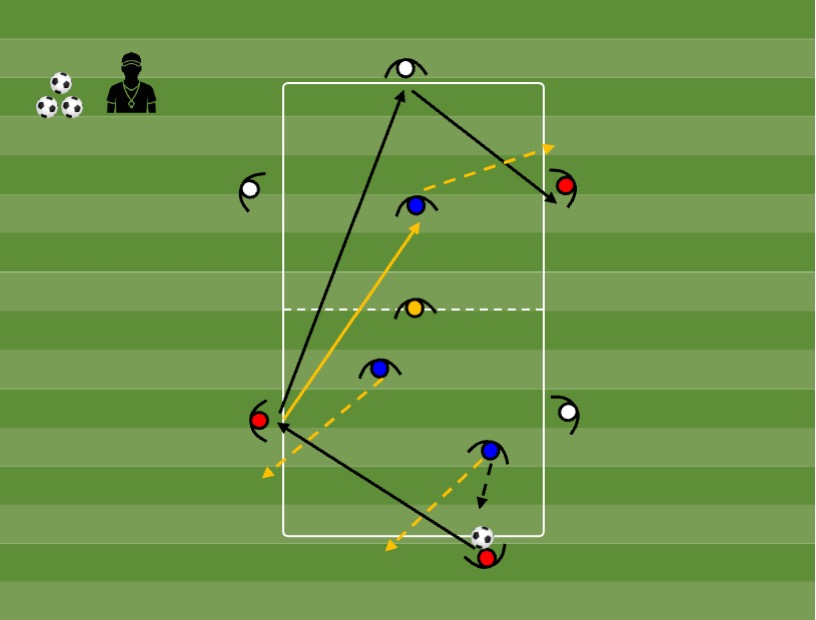
| Objective | Offensive transition: find the safe pass after winning the ball. Defensive transition: press immediately after losing the ball |
| Players | 10-20 players (3 teams of 3 + 1 interior joker) |
| Materials | Cones, bibs and balls |
| Space | 20x30m |
| Duration | 3-5 sets x 3-4 min per set |
| Category | Rondo |
A rondo with 2 spaces is played where the ball-possessing team (2 groups of 3 plus 1 interior joker) must maintain possession through passes, constant movement and association triangles, then progress via a pass to the players waiting in the other square.
The objective for the defending team is to recover the ball through interception or tackle, make a safe pass and take up the positions vacated by the team that lost the ball.
Offensive transition: find the safe pass. Defensive transition: focus on pressing immediately after losing the ball.
Variation: reduce the space to increase defensive intensity or add a touch limit to force faster play. You can also add a joker to create numerical superiority and facilitate learning.
Rondo 4v4 + 3 jokers
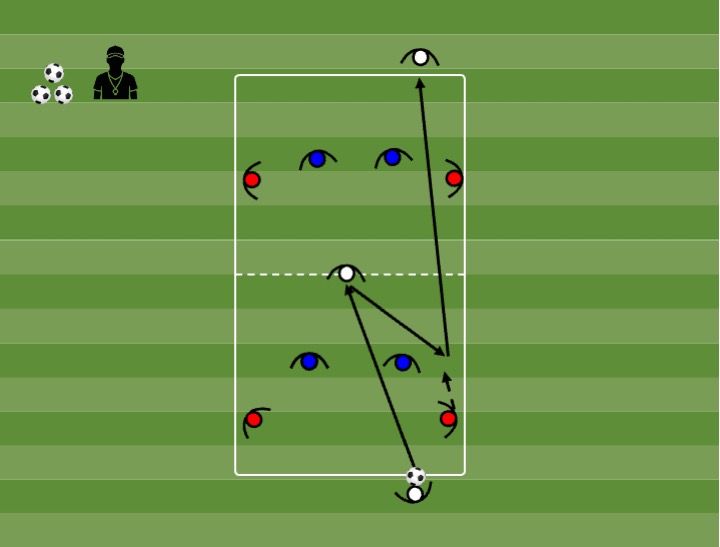
| Objective | Offensive transition: find the safe pass after winning the ball. Defensive transition: press immediately after losing the ball |
| Players | 11-22 players (2 teams of 4 + 3 jokers) |
| Materials | Cones, discs, bibs and balls |
| Space | 1 rectangle divided into 2 squares of 6-9 m per side |
| Duration | 3-6 sets x 2-4 min per set |
| Category | Rondo |
A rondo with 2 spaces is played where the attacking team (red) must complete 4 passes or make a third-man run to progress via a pass to the waiting players in the other square. Players must offer constant passing lines and form association triangles.
If the attacking team loses the ball they try to win it back as quickly as possible through immediate pressure.
Offensive transition: find the safe pass. Defensive transition: focus on pressing immediately after losing the ball.
Variation: reduce the space to increase defensive intensity or add a touch limit to force faster play. You can also add a joker to create numerical superiority and facilitate learning.
Possession 3+3v3
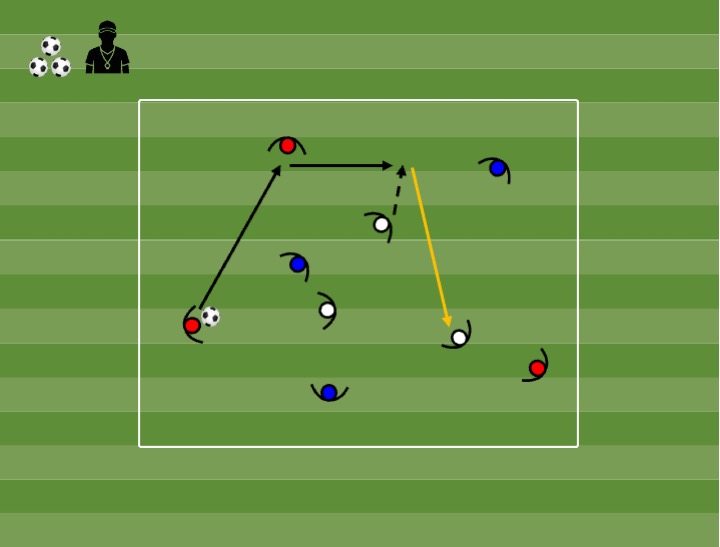
| Objective | Offensive transition: find the safe pass after winning the ball. Defensive transition: press immediately after losing the ball |
| Players | 9-20 players (3 teams of 3). Can run 2 simultaneous tasks |
| Materials | Cones, discs, 3 sets of bibs and balls |
| Space | 1 square of 12-18 m per side |
| Duration | 3-4 sets x 3-5 min per set |
| Category | Small-sided possession |
A 6v3 possession game is played. The objective for the attacking team (red and blue) is to maintain possession through passes, constant movement and forming association triangles.
When the defending team (white) wins the ball they join possession with the team that did not lose it — THIS IS THE KEY MOMENT TO FIND THE SAFE PASS. The team that lost the ball must immediately press — THIS IS THE KEY MOMENT TO PRESS AFTER LOSING THE BALL.
Offensive transition: help find the safe pass. Defensive transition: focus on pressing after losing the ball.
Variation: reduce the space to increase defensive intensity or add a touch limit to force faster play. You can also add a joker to create numerical superiority and facilitate learning.
Build your full session with FutCoach
FutCoach generates complete training sessions for U16 players in seconds. Select your age group, the session objective (high press) and the number of players, and the AI creates a complete session for you with warm-up, main block and cool-down. Download FutCoach free and prepare your next high press session in less than 2 minutes. No blank templates, no improvising on the field.
Frequently asked questions
When is the right time to introduce high press with U16 players?
At U16 (15-16 years) players can already implement sophisticated press triggers and coordinate pressing traps as a team. The important thing is to build a shared understanding of when and how to press. Work on reading the game together and synchronising the moment of pressure.
How many players do I need to practise high press?
Most high press exercises work with 8-16 players. Rondos and possession games with defensive transition can be done from 6 players. The key is to have one group pressing and another group trying to maintain possession, with enough space for the pressure to make sense.
How much time should I dedicate to high press in each session?
"For U16, between 20 and 30 minutes per session is enough if you work with intensity and specific corrections. You can incorporate pressing exercises within the collective tactical block as a complement to the usual defensive work, or dedicate a full session to it when preparing for a specific opponent."
Related articles
High pressure exercises for U8 players
Planning high pressure exercises for U8 players can be a real headache. At this age (6-8 years), players are learning to understan...
High pressure exercises for U10 players
Planning high pressure exercises for U10 players can be a real headache. At this age (9-10 years), players are learning to underst...
High pressure exercises for U12 players
Planning high pressure exercises for U12 players can be a real headache. At this age (11-12 years), players are learning to unders...