
Dribbling and ball control exercises for U16 players
Dribbling and ball control are the most individual skills in football. At U16 (15-16 years), 1v1, 2v1 and 2v2 exercises at full game intensity are the tool for maintaining individual technique at its peak — and for developing the decisive quality that differentiates players at the top of youth football. In this article you will find 5 dribbling and ball control exercises for U16 players, with objective, materials, space, duration and a variation for each one. Exercises that work 1v1, 2v1 and 2v2 at maximum competitive intensity with mini-goals.
Why work on dribbling and ball control with U16 players?
Dribbling and ball control are the most individual technical skills in football, and their development is especially important at the perfection stage (15-16 years). A player who solves 1v1 situations with confidence, fixes defenders and frees teammates in a 2v1 is a player who makes the difference. Three pedagogical principles to keep in mind. First, maximum intensity: at U16, all 1v1 exercises must be performed at full game pace. Second, decision-making: the player must know when to dribble and when to play the combination — individual quality must be intelligent. Third, 2v1 and 2v2: work on the combination with another player to develop the attacking relationship alongside the individual technique. These exercises work on these principles through 1v1, 2v1 and 2v2 situations at maximum intensity.
Exercises 5
2v1
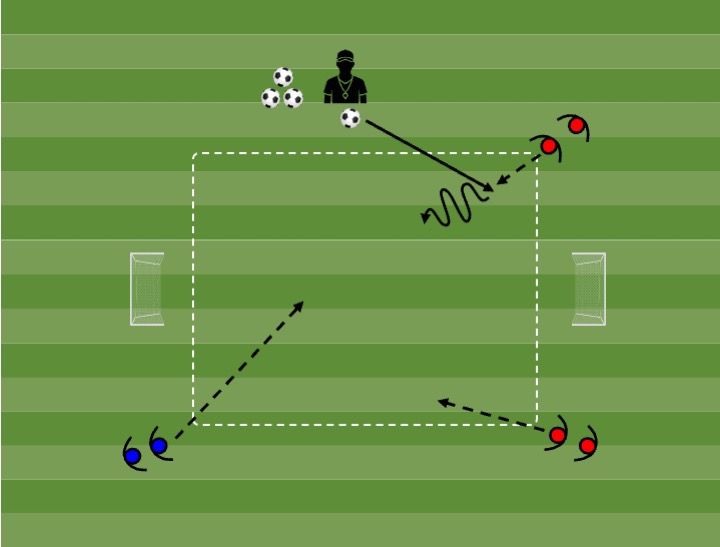
| Objective | Fix to free a player. Improve 2v1 attacking play, dribbling and feints. Improve 1v2 defending |
| Players | 2 groups of 4-10 players each team |
| Materials | Balls, mini-goals and bibs |
| Space | Rectangle of 6-20 m per side |
| Duration | 2-4 sets x 4-10 min per set |
| Category | Individual technique |
The task consists of a 2v1 game in a delimited space with 2 mini-goals, with the objective of scoring a goal. The attacking players (RED) must perform a fix-and-pass or dribble action past the defender.
In the mini-goal. The defending player (BLUE) must win the ball back and score in the mini-goal. Players within the same team rotate during the set; at the end of each set teams switch roles, changing from attacker to defender.
Focus on dribbling speed, the technical gesture of dribbling and defensive positioning.
Variation: reduce the space to increase defensive intensity or add a touch limit to force faster play. You can also add a joker to create numerical superiority and facilitate learning.
Want a full session with these drills? FutCoach generates it in seconds.
Try FutCoach free1v1
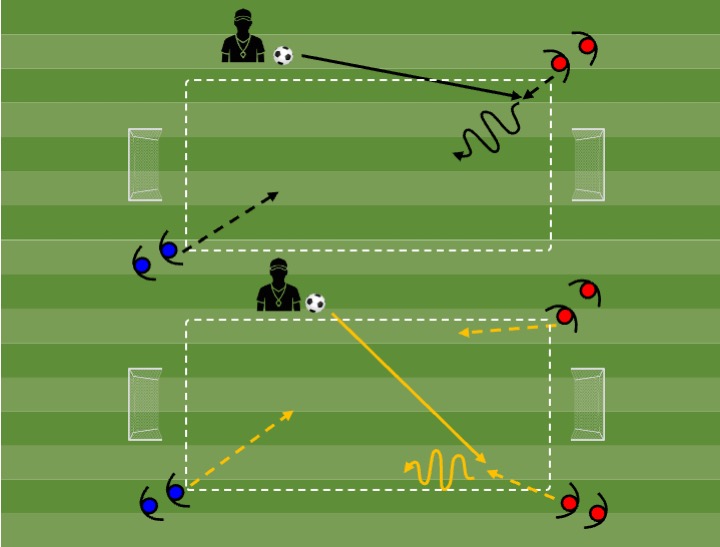
| Objective | Fix to free a player. Improve 1v1 and 2v1 attacking play, dribbling and feints. Improve 1v1 defending |
| Players | 2 groups of 4-10 players each team |
| Materials | Balls, mini-goals and bibs |
| Space | Rectangle of 6-20 m per side |
| Duration | 2-4 sets x 4-10 min per set |
| Category | Individual technique |
The task consists of a 1v1 game in a delimited space with 2 mini-goals, with the objective of scoring a goal. The attacking player (RED) must perform a dribble past the defender.
(BLUE) and score in the mini-goal. The defending player (BLUE) must win the ball back and score in the mini-goal. Teams rotate roles each set, switching attacker and defender.
Focus on dribbling speed, the technical gesture of dribbling and defensive positioning.
Variation: reduce the space to increase defensive intensity or add a touch limit to force faster play. You can also add a joker to create numerical superiority and facilitate learning.
2v2
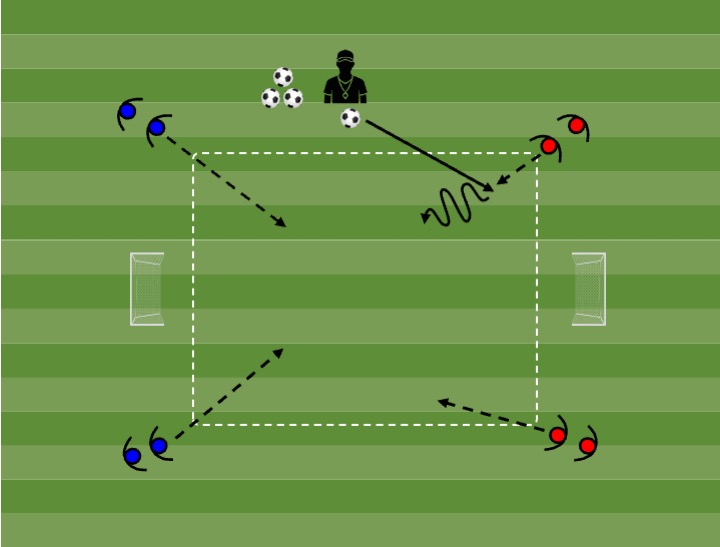
| Objective | Fix to free a player. Improve 2v2 attacking play, offensive relationships, dribbling and feints. Improve 2v2 defending |
| Players | 2 groups of 4-10 players each team |
| Materials | Balls, mini-goals and bibs |
| Space | Rectangle of 6-20 m per side |
| Duration | 2-4 sets x 4-10 min per set |
| Category | Individual technique |
The task consists of a 2v2 game in a delimited space with 2 mini-goals, with the objective of scoring a goal. The attacking players (RED) must perform a fix-and-pass or dribble action past the defenders.
In the mini-goal. The defending team (BLUE) must win the ball back and score in the mini-goal. Players within the same team rotate during the set; at the end of each set teams switch roles, changing from attacker to defender.
Focus on dribbling speed, the technical gesture of dribbling and defensive positioning.
Variation: reduce the space to increase defensive intensity or add a touch limit to force faster play. You can also add a joker to create numerical superiority and facilitate learning.
2v2
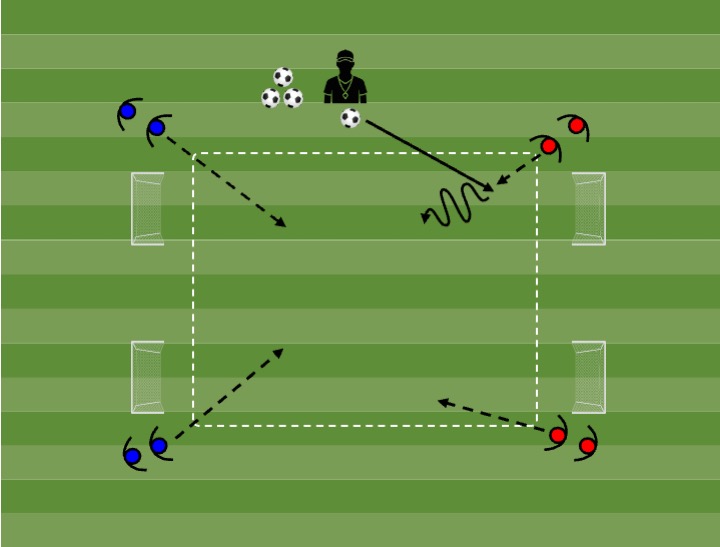
| Objective | Fix to free a player. Improve 2v2 attacking play, offensive relationships, dribbling and feints. Improve 2v2 defending |
| Players | 2 groups of 4-10 players each team |
| Materials | Balls, mini-goals and bibs |
| Space | Rectangle of 6-20 m per side |
| Duration | 2-4 sets x 4-10 min per set |
| Category | Individual technique |
The task consists of a 2v2 game in a delimited space with 4 mini-goals, with the objective of scoring a goal. The attacking players (RED) must perform a fix-and-pass or dribble action past the defenders.
In the mini-goals. The defending team (BLUE) must win the ball back and score in the mini-goals. Players within the same team rotate during the set; at the end of each set teams switch roles, changing from attacker to defender.
Focus on dribbling speed, the technical gesture of dribbling and defensive positioning.
Variation: reduce the space to increase defensive intensity or add a touch limit to force faster play. You can also add a joker to create numerical superiority and facilitate learning.
2v2
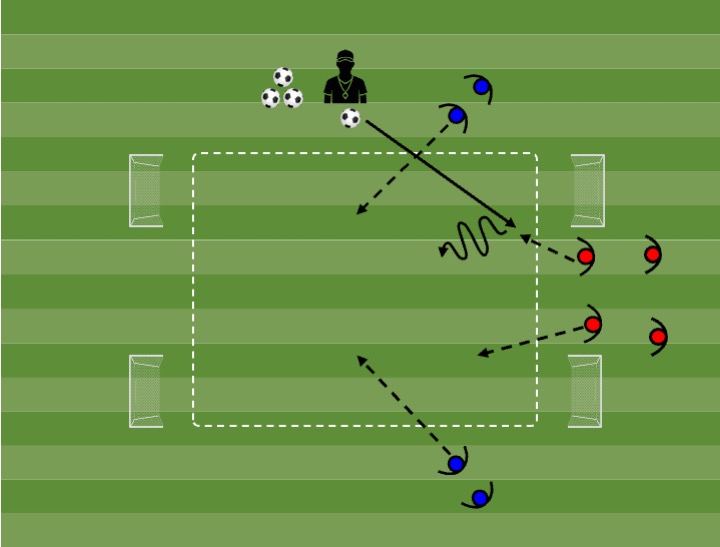
| Objective | Fix to free a player. Improve 2v2 attacking play, offensive relationships, dribbling and feints. Improve 2v2 defending and recovery run |
| Players | 2 groups of 4-10 players each team |
| Materials | Balls, mini-goals and bibs |
| Space | Rectangle of 6-20 m per side |
| Duration | 2-4 sets x 4-10 min per set |
| Category | Individual technique |
The task consists of a 2v2 game in a delimited space with 4 mini-goals, with the objective of scoring a goal. The attacking players (RED) must perform a fix-and-pass or dribble action past the defenders.
In the mini-goals. The defending team (BLUE) must win the ball back and score in the mini-goals. Players within the same team rotate during the set; at the end of each set teams switch roles, changing from attacker to defender.
Focus on the recovery run, dribbling speed, the technical gesture of dribbling and defensive positioning.
Variation: reduce the space to increase defensive intensity or add a touch limit to force faster play. You can also add a joker to create numerical superiority and facilitate learning.
Build your full session with FutCoach
FutCoach generates complete training sessions for U16 players in seconds. Select your age group, the session objective (dribbling and ball control) and the number of players, and the AI creates a complete session for you with warm-up, main block and cool-down. Download FutCoach free and prepare your next dribbling session in less than 2 minutes. No blank templates, no improvising on the field.
Frequently asked questions
When is a U16 player considered to have mastered ball control?
A U16 player (15-16 years) masters ball control when they can control the ball with both feet at different rhythms under pressure, change direction and solve 1v1 situations with feints and speed changes with automatism and consistency.
Is dribbling taught or is it an innate quality?
Dribbling has a component of personality and confidence that cannot be taught directly, but the technique can be worked on. At U16 (15-16 years), the player should already have their personal repertoire consolidated. The work focuses on applying it at maximum intensity and with smart decision-making in competitive situations.
How many 1v1 exercises should I include in each session?
"For U16 (15-16 years), including one or two 1v1 exercises per week is sufficient if the intensity is maximum. Quality and intensity are the only variables that matter at this level. The 1v1 can appear in the warm-up, as the main technical task or integrated into a small-sided game format."
Related articles
Dribbling and ball control exercises for U8 players
Dribbling and ball control are the most individual skills in football. At U8 (6-8 years), developing ball control at different spe...
Dribbling and ball control exercises for U10 players
Dribbling and ball control are the most individual skills in football. At U10 (9-10 years), developing ball control at different s...
Dribbling and ball control exercises for U12 players
Dribbling and ball control are the most individual skills in football. At U12 (11-12 years), consolidating 1v1 technique in attack...