
Dribbling and ball control exercises for U10 players
Dribbling and ball control are the most individual skills in football. At U10 (9-10 years), developing ball control at different speeds and 1v1 play both in attack and defence is key for building a technically complete and self-confident player. In this article you will find 5 dribbling and ball control exercises for U10 players, with objective, materials, space, duration and a variation for each one. Exercises that teach players to face opponents with confidence, develop feints and improve their defensive positioning in 1v1 situations.
Why work on dribbling and ball control with U10 players?
Dribbling and ball control are the most individual technical skills in football, and their development is especially important at the initiation-development stage (9-10 years). A player who dribbles with confidence and solves 1v1 situations creates opportunities that no tactical system can replace. Three pedagogical principles to keep in mind when working on dribbling with U10 players. First, confidence: encourage the player to try the dribble — mistakes are part of learning. Second, specific feints: work on concrete technical gestures (body feint, step-over, speed change) so the player has different resources available. Third, 1v1 in both directions: attack and defence — the player must know how to dribble and how to defend. These exercises work on these principles through 1v1 situations with mini-goals in realistic, competitive contexts.
Exercises 5
1v1
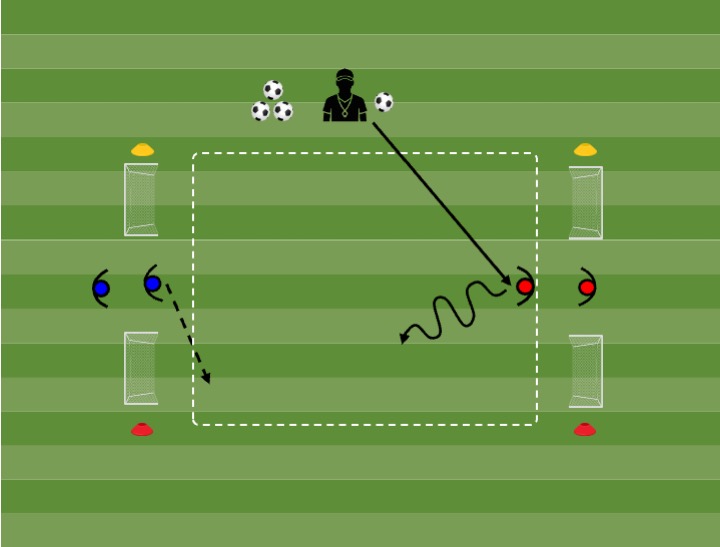
| Objective | Improve 1v1 attacking play, oriented control, dribbling and feints. Improve 1v1 defending, defensive positioning and tackling |
| Players | 2 groups of 4-10 players each team |
| Materials | Balls, mini-goals and bibs |
| Space | Rectangle of 6-20 m per side |
| Duration | 2-4 sets x 4-10 min per set |
| Category | Individual technique |
The task consists of a 1v1 game in a delimited space with 4 mini-goals, with the objective of scoring a goal. The attacking player (RED) must perform an oriented control + dribble past the defender indicated by the coach in advance.
Past the defender (BLUE) and score in the mini-goal. The defending player (BLUE) must win the ball back and score in any of the mini-goals. Players within the same team rotate during the set and teams switch roles each set.
Focus on the technical gesture of control, dribbling and the timing of the tackle.
Variation: reduce the space to increase defensive intensity or add a touch limit to force faster play. You can also add a joker to create numerical superiority and facilitate learning.
Want a full session with these drills? FutCoach generates it in seconds.
Try FutCoach free1v1
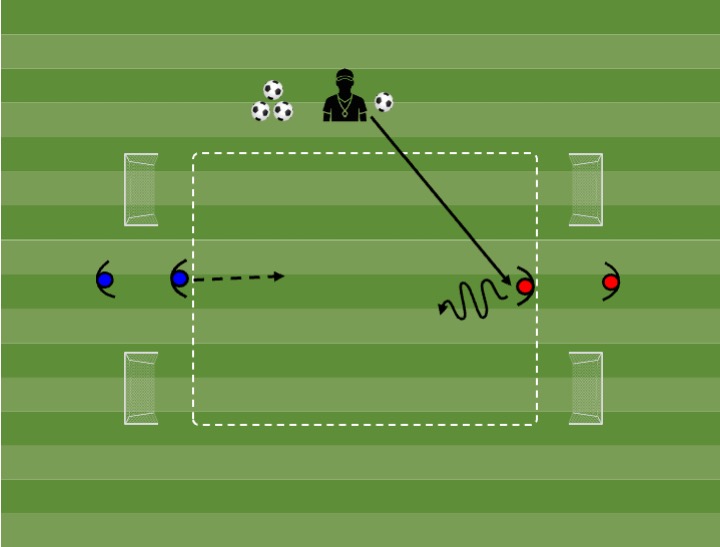
| Objective | Improve 1v1 attacking play, dribbling and feints. Improve 1v1 defending, defensive positioning and tackling |
| Players | 2 groups of 4-10 players each team |
| Materials | Balls, mini-goals and bibs |
| Space | Rectangle of 6-20 m per side |
| Duration | 2-4 sets x 4-10 min per set |
| Category | Individual technique |
The task consists of a 1v1 game in a delimited space with 4 mini-goals, with the objective of scoring a goal. The attacking player (RED) must perform a dribble past the defender.
(BLUE) and score in the mini-goals. The defending player (BLUE) must win the ball back and score in the mini-goals. Teams rotate roles each set, switching attacker and defender.
Focus on the technical gesture of dribbling, defensive positioning and the timing of the tackle.
Variation: reduce the space to increase defensive intensity or add a touch limit to force faster play. You can also add a joker to create numerical superiority and facilitate learning.
1v1
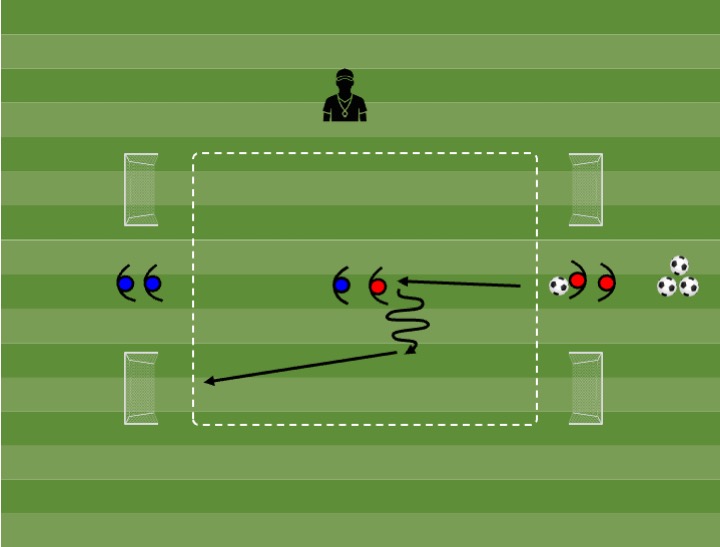
| Objective | Improve 1v1 attacking play, body feint, dribbling and shielding. Improve 1v1 defending, defensive positioning and tackling |
| Players | 2 groups of 6-10 players each team |
| Materials | Balls, mini-goals and bibs |
| Space | Rectangle of 6-20 m per side |
| Duration | 2-4 sets x 4-10 min per set |
| Category | Individual technique |
The task consists of a 1v1 game in a delimited space with 4 mini-goals, with the objective of scoring a goal. The attacking player (RED) must perform a body feint (screening action) past the defender.
(BLUE) and then score in the mini-goals. The defending player (BLUE) must win the ball back and score in the mini-goals. Teams rotate roles each set, switching attacker and defender.
Focus on the technical gesture of the body feint, dribbling and the timing of the tackle.
Variation: reduce the space to increase defensive intensity or add a touch limit to force faster play. You can also add a joker to create numerical superiority and facilitate learning.
1v1
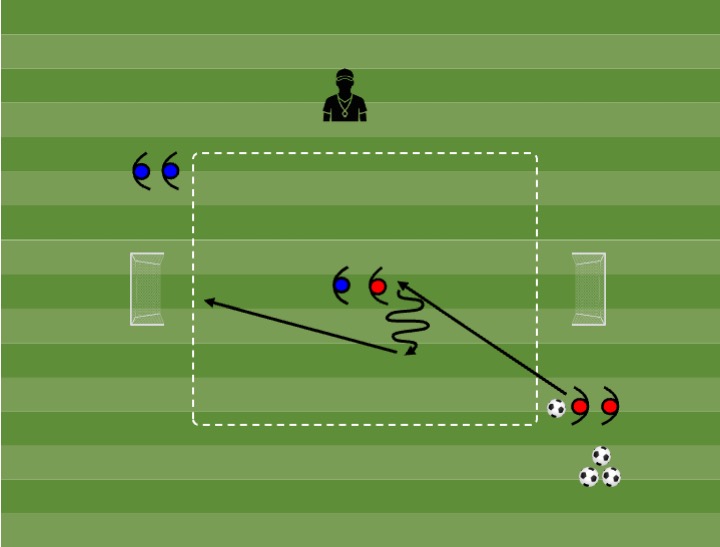
| Objective | Improve 1v1 attacking play, body feint, dribbling and shielding. Improve 1v1 defending, defensive positioning and tackling |
| Players | 2 groups of 6-10 players each team |
| Materials | Balls, mini-goals and bibs |
| Space | Rectangle of 6-20 m per side |
| Duration | 2-4 sets x 4-10 min per set |
| Category | Individual technique |
The task consists of a 1v1 game in a delimited space with 2 mini-goals, with the objective of scoring a goal. The attacking player (RED) must perform a body feint (screening action) past the defender.
(BLUE) and then score in the mini-goal. The defending player (BLUE) must win the ball back and score in the mini-goal. Teams rotate roles each set, switching attacker and defender.
Focus on the technical gesture of the body feint, dribbling and the timing of the tackle.
Variation: reduce the space to increase defensive intensity or add a touch limit to force faster play. You can also add a joker to create numerical superiority and facilitate learning.
1v1
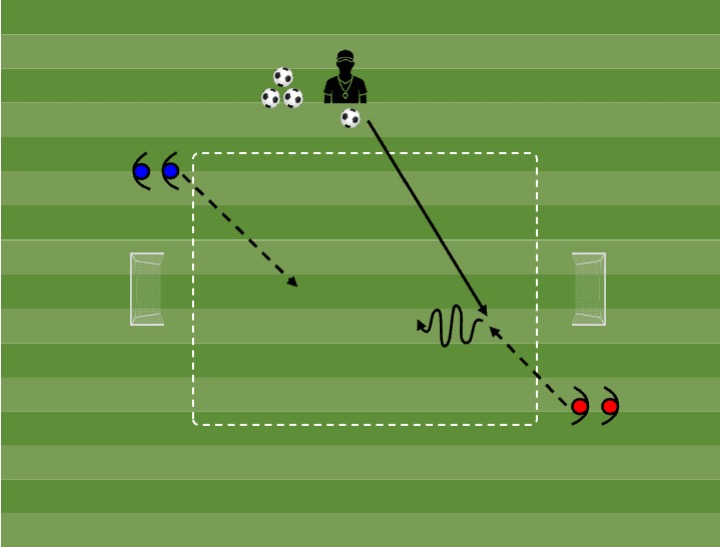
| Objective | Improve 1v1 attacking play, dribbling and feints. Improve 1v1 defending, defensive positioning and tackling |
| Players | 2 groups of 4-10 players each team |
| Materials | Balls, mini-goals and bibs |
| Space | Rectangle of 6-20 m per side |
| Duration | 2-4 sets x 4-10 min per set |
| Category | Individual technique |
The task consists of a 1v1 game in a delimited space with 2 mini-goals, with the objective of scoring a goal. The attacking player (RED) must perform a dribble past the defender.
(BLUE) and score in the mini-goal. The defending player (BLUE) must win the ball back and score in the mini-goal. Teams rotate roles each set, switching attacker and defender.
Focus on the technical gesture of dribbling and the timing of the tackle.
Variation: reduce the space to increase defensive intensity or add a touch limit to force faster play. You can also add a joker to create numerical superiority and facilitate learning.
Build your full session with FutCoach
FutCoach generates complete training sessions for U10 players in seconds. Select your age group, the session objective (dribbling and ball control) and the number of players, and the AI creates a complete session for you with warm-up, main block and cool-down. Download FutCoach free and prepare your next dribbling session in less than 2 minutes. No blank templates, no improvising on the field.
Frequently asked questions
When is a U10 player considered to have mastered ball control?
A U10 player (9-10 years) masters ball control when they can control the ball with both feet, at different rhythms and without needing to look at it constantly. At this age the player should also be able to change direction while dribbling without losing control.
Is dribbling taught or is it an innate quality?
Dribbling has a component of personality and confidence that cannot be taught directly, but the technique can be worked on. At U10 (9-10 years), the specific gestures — body feint, step-over, speed change — can already be worked on systematically. The key is to create 1v1 game situations that encourage the player to use these gestures competitively.
How many 1v1 exercises should I include in each session?
"For U10 (9-10 years), including one or two 1v1 exercises per week is sufficient if the intensity is high. Quality is more important than quantity. The 1v1 can appear in the warm-up, as the main technical task or integrated into a small-sided game."
Related articles
Dribbling and ball control exercises for U8 players
Dribbling and ball control are the most individual skills in football. At U8 (6-8 years), developing ball control at different spe...
Dribbling and ball control exercises for U12 players
Dribbling and ball control are the most individual skills in football. At U12 (11-12 years), consolidating 1v1 technique in attack...
Dribbling and ball control exercises for U14 players
Dribbling and ball control are the most individual skills in football. At U14 (13-14 years), consolidating 1v1 technique under pre...