
Defensive transition exercises for U14 players
Losing the ball is inevitable in football, but what happens in the next three seconds can be decisive. The attacking-to-defensive transition — also called recovery or counterpressing — is one of the most critical phases of the modern game, and working on it consistently from U14 is what separates organised teams from those that concede on every mistake. In this article you will find 5 defensive transition exercises for U14 players (13-14 years), with objective, materials, space, duration and a variation for each one. Exercises that teach your players how to react immediately after losing the ball, press with collective criteria and recover their defensive structure.
Why work on defensive transition with U14 players?
The attacking-to-defensive transition — or defensive recovery — is one of the most critical moments in modern football. For U14 teams (13-14 years), teaching players to react after losing the ball is a skill that requires clarity, organisation and repetition. Three pedagogical principles to bear in mind. First, the player who loses the ball must be the first to press: immediate reaction within the first three seconds. Second, the nearest teammates must close passing lanes and reduce space to prevent a quick counter-attack. Third, the rest of the team must recover their shape rapidly, establishing a defensive block. These exercises work on these principles through passing circuits and rondos with transition moments that combine offensive and defensive phases.
Exercises 5
Offensive evolutions
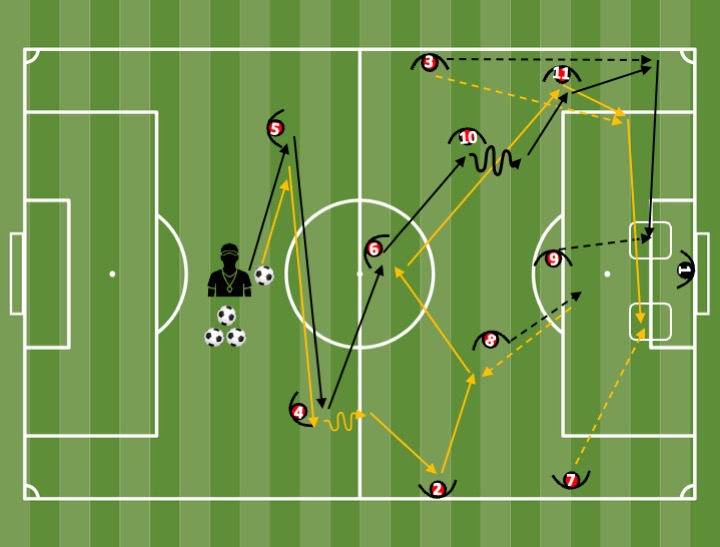
| Objective | Initiate the attack, progress the attack, finish the attack with cross-shot, reach shooting zones |
| Players | 10-20 players + 1-2 goalkeepers |
| Materials | Balls |
| Space | Half-pitch to full pitch |
| Duration | 2-4 sets x 4-6 min per set |
| Category | Evolutions |
The task consists of a passing circuit in specific positions in which ball circulation sequences finishing in goal are performed.
Perform the 2 passing sequences consecutively in the order BLACK-ORANGE. Performed by time; after each set change the side from which the task starts.
Focus on ball control, pass execution, circulation speed, the timing of the run-and-shot and the technical gesture of the shot.
Variation: reduce the space to increase defensive intensity or add a touch limit to force faster play. You can also add a joker to create numerical superiority and facilitate learning.
Want a full session with these drills? FutCoach generates it in seconds.
Try FutCoach freeOffensive evolutions
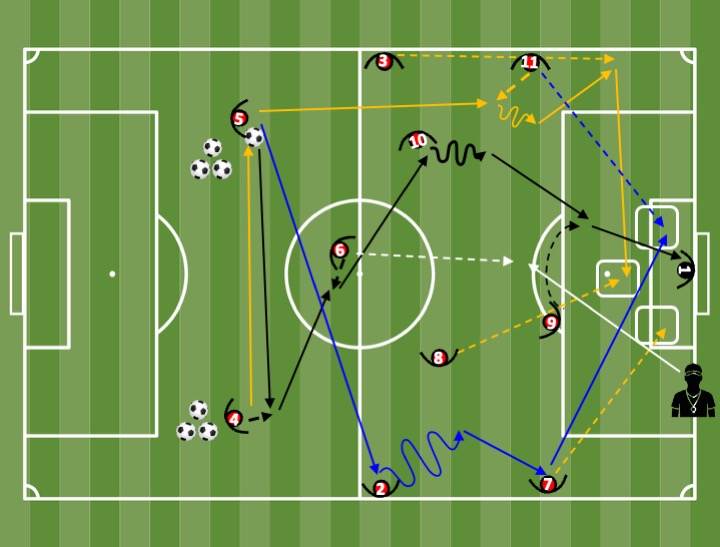
| Objective | Initiate the attack, progress the attack, finish the attack with cross-shot and with combination play in the box |
| Players | 10-20 players + 1-2 goalkeepers |
| Materials | Balls |
| Space | Half-pitch to full pitch |
| Duration | 2-4 sets x 4-6 min per set |
| Category | Evolutions |
The task consists of a passing circuit in specific positions in which ball circulation sequences finishing in goal are performed.
Perform the 4 passing sequences consecutively in the order BLACK-BLUE-ORANGE-WHITE. Performed by time; after each set change the side from which the task starts.
Focus on ball control, pass execution, circulation speed, the timing of the run-and-shot and zone occupation.
Variation: reduce the space to increase defensive intensity or add a touch limit to force faster play. You can also add a joker to create numerical superiority and facilitate learning.
Offensive evolutions
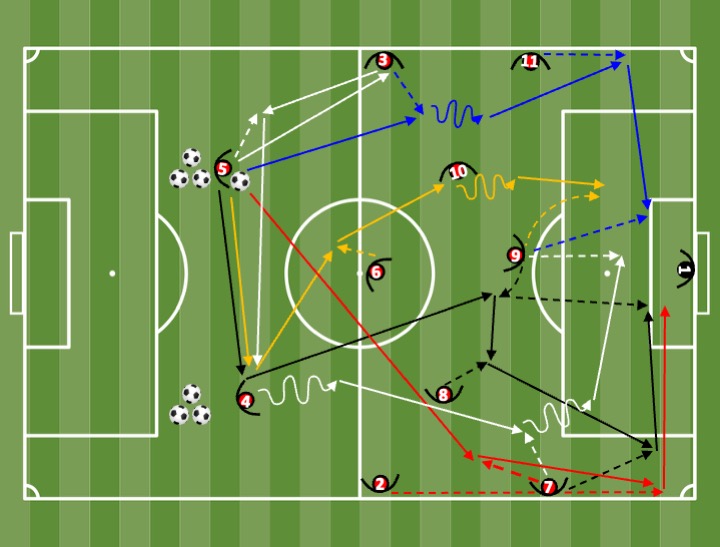
| Objective | Initiate the attack, progress the attack (through central and wide channels), finish the attack with cross-shot |
| Players | 10-20 players + 1-2 goalkeepers |
| Materials | Balls |
| Space | Half-pitch to full pitch |
| Duration | 2-4 sets x 4-6 min per set |
| Category | Evolutions |
The task consists of a passing circuit in specific positions in which ball circulation sequences finishing in goal are performed.
Perform the 5 passing sequences consecutively in the order BLACK-ORANGE-WHITE-BLUE. Performed by time; after each set change the side from which the task starts.
Focus on ball control, pass execution, circulation speed, the timing of the run-and-shot and zone occupation.
Variation: reduce the space to increase defensive intensity or add a touch limit to force faster play. You can also add a joker to create numerical superiority and facilitate learning.
Offensive evolutions
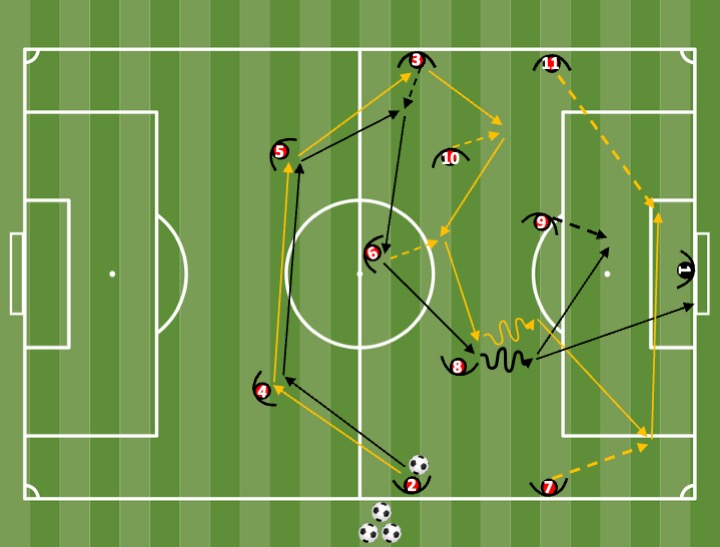
| Objective | Initiate the attack (defensive circulation), progress the attack (from wide channel), finish the attack (solutions from wide channel) |
| Players | 10-20 players + 1-2 goalkeepers |
| Materials | Balls |
| Space | Half-pitch to full pitch |
| Duration | 2-4 sets x 4-6 min per set |
| Category | Evolutions |
The task consists of a passing circuit in specific positions in which ball circulation sequences finishing in goal are performed. There is no rotation in the circuit. There are 2 variants (black, orange).
Perform the 2 passing sequences consecutively in the order BLACK-ORANGE. Performed by time; after each set change the side from which the task starts (left or right profile), performing the task on both sides.
Focus on ball control, pass execution, circulation speed, the timing of the run-and-shot and zone occupation.
Variation: reduce the space to increase defensive intensity or add a touch limit to force faster play. You can also add a joker to create numerical superiority and facilitate learning.
Rondo 4v4 + 3 jokers
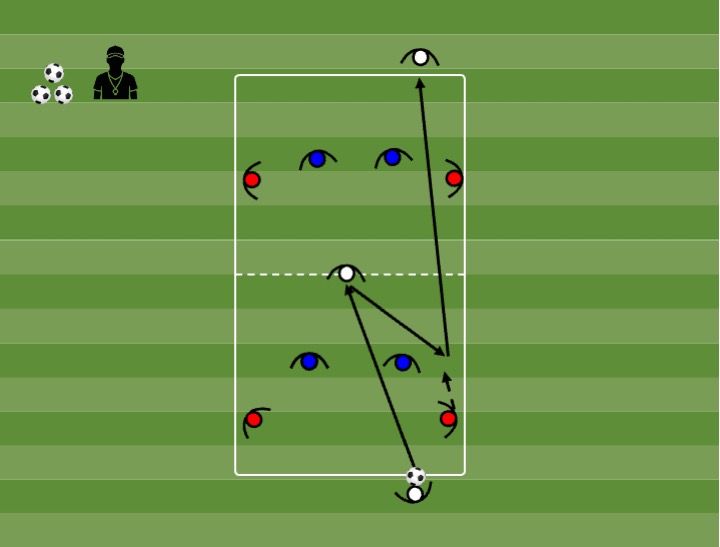
| Objective | Offensive transition: find the safe pass after winning the ball. Defensive transition: press immediately after losing the ball |
| Players | 11-22 players (2 teams of 4 + 3 jokers) |
| Materials | Cones, discs, bibs and balls |
| Space | 1 rectangle divided into 2 squares of 6-9 m per side |
| Duration | 3-6 sets x 2-4 min per set |
| Category | Rondo |
A rondo with 2 spaces is played in which the attacking team (red) must achieve 4 or more passes in a row with the help of the jokers. The jokers always play with the team in possession.
If the attacking team loses the ball they try to recover it immediately through pressing after loss. The defending team (blue) tries to win the ball back by pressing and, when they recover it, they become the attackers with the jokers.
Offensive transition: find the safe pass. Defensive transition: focus on pressing immediately after losing the ball.
Variation: reduce the space to increase defensive intensity or add a touch limit to force faster play. You can also add a joker to create numerical superiority and facilitate learning.
Build your full session with FutCoach
FutCoach generates complete training sessions for U14 players in seconds. Select your age group, the session objective (defensive transition) and the number of players, and the AI creates a complete session for you with warm-up, main block and cool-down. Download FutCoach free and prepare your next defensive transition session in less than 2 minutes. No blank templates, no improvising on the field.
Frequently asked questions
What is the difference between recovery and counterpressing?
Recovery involves retreating in an organised way towards your own goal to re-establish the defensive structure. Counterpressing (also known as gegenpressing) is the action of pressing the opponent immediately after losing the ball, before they can organise their attack. Both are part of the defensive transition, but they happen at different moments and with different objectives.
From what age can you start working on the attacking-to-defensive transition?
At U14 (13-14 years) it is already possible to work on immediate reaction after losing the ball. The key is to simplify: the player who loses the ball is the first to press, and their nearest teammates close the passing lanes. As players mature, the collective recovery of defensive shape is introduced.
How many players do I need to work effectively on defensive transition?
"The best defensive transition exercises work with 8-16 players. Rondos with transition (when the possessing team loses the ball, the team that lost it must press immediately) can be done from 7-8 players. Attack-defence situations with recovery of shape need a minimum of 10-12 players."
Related articles
Defensive transition exercises for U8 players
The retreat consists of moving back in an organised way towards your own goal to recover the defensive structure. Every team that ...
Defensive transition exercises for U10 players
The retreat consists of moving back in an organised way towards your own goal to recover the defensive structure. Every team that ...
Defensive transition exercises for U12 players
The retreat consists of moving back in an organised way towards your own goal to recover the defensive structure. Every team that ...