
Ball build-out exercises for U14 players
Knowing how to play the ball out from the back is one of the hallmarks of modern football teams. For U14 players (13-14 years), the build-up phase becomes more demanding: players must manage pressure, switch play and progress through zones with tactical intelligence. In this article you will find 5 ball build-out exercises for U14 players, with complete structure: objective, players, materials, space, duration and how to progress or simplify each task. Everything you need to work on build-up play effectively with your team.
Why work on ball build-out with U14 players?
Ball build-out is the first phase of possession play and is hugely important in the identity of any team. At U14 (13-14 years), learning to build from the back under pressure, using the full width of the pitch and finding the player who breaks lines, is one of the most important tactical challenges of this stage. Three pedagogical principles to keep in mind when working on build-out with U14 players. First, body positioning: the player receiving the ball must be ready to play forward. Second, width and depth: the build-out requires players to occupy wide and deep positions to create passing lines. Third, the decision under pressure: the ball-carrier must identify when to keep possession short and when to play the switch or the pass that breaks the press. These exercises work on these principles through collective technique tasks and possession exercises that progressively increase pressure.
Exercises 5
Collective technique
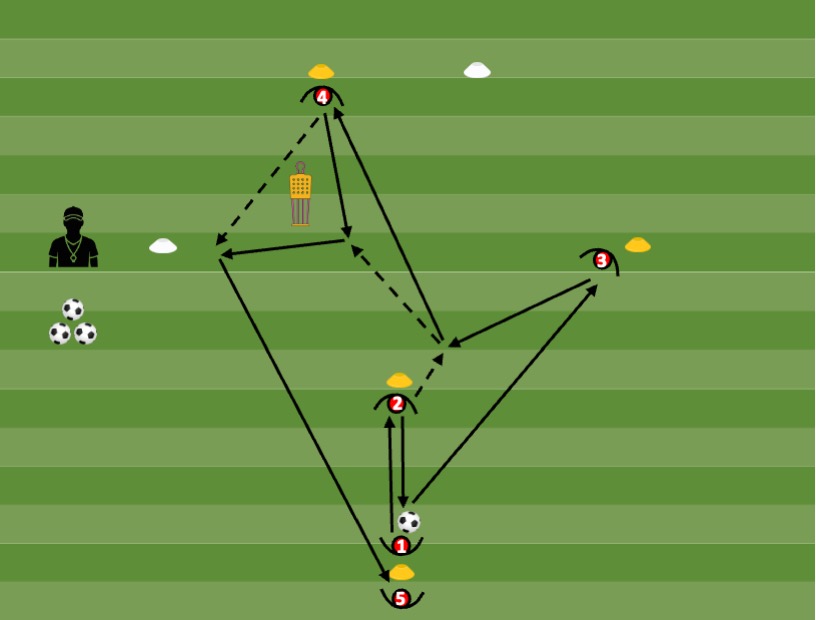
| Objective | Improve body positioning, control, passing, one-two combinations and third-man runs |
| Players | 5-20 players |
| Materials | Cones, discs and balls |
| Space | 20x30m |
| Duration | 2-4 sets x 4-6 min per set |
| Category | Collective technique |
The task consists of a passing circuit in which various technical actions are performed.
In the circuit follow the numerical rotation.
Focus on pass execution, the timing of the one-two combination and the third-man run.
Variation: reduce the space to increase defensive intensity or add a touch limit to force faster play. You can also add a joker to create numerical superiority and facilitate learning.
Want a full session with these drills? FutCoach generates it in seconds.
Try FutCoach freeCollective technique
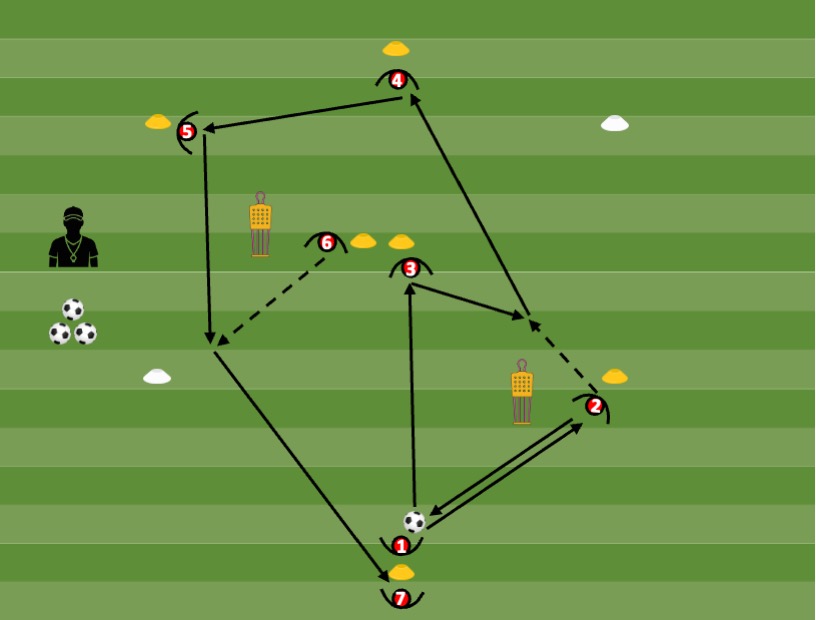
| Objective | Improve body positioning, control, passing, penetrating runs and third-man runs |
| Players | 7-20 players |
| Materials | Cones, discs and balls |
| Space | 20x30m |
| Duration | 2-4 sets x 4-6 min per set |
| Category | Collective technique |
The task consists of a passing circuit in which various technical actions are performed.
In the circuit follow the numerical rotation.
Focus on pass execution, the timing of the pass-and-run and the third-man combination.
Variation: reduce the space to increase defensive intensity or add a touch limit to force faster play. You can also add a joker to create numerical superiority and facilitate learning.
Collective technique
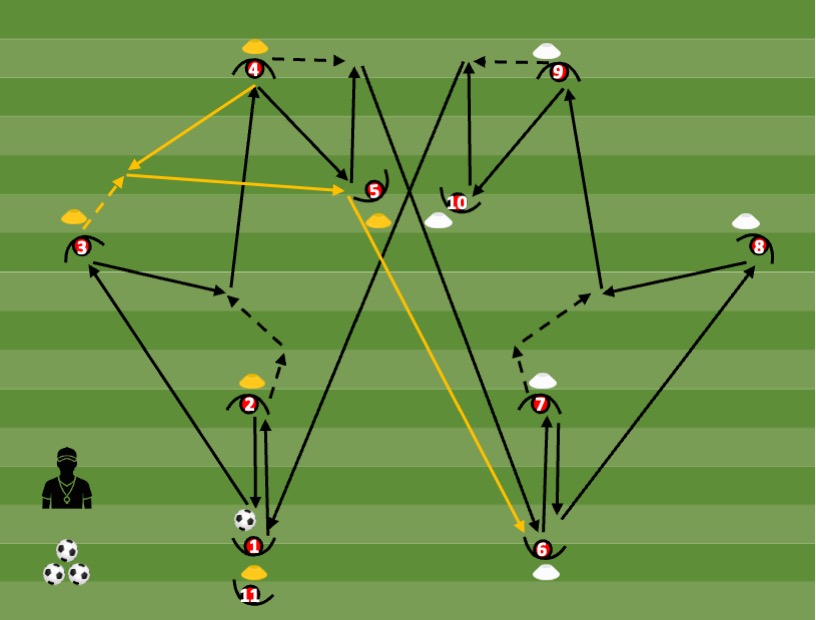
| Objective | Improve body positioning, control, passing, medium-long passing and third-man runs |
| Players | 11-22 players |
| Materials | Cones, discs and balls |
| Space | 20x30m |
| Duration | 2-4 sets x 4-6 min per set |
| Category | Collective technique |
The task consists of a passing circuit with 2 variants (black and orange) in which various technical actions are performed.
In the circuit follow the numerical rotation.
Focus on pass execution and the timing of the third-man combination.
Variation: reduce the space to increase defensive intensity or add a touch limit to force faster play. You can also add a joker to create numerical superiority and facilitate learning.
Passing circuit (2+2v2)
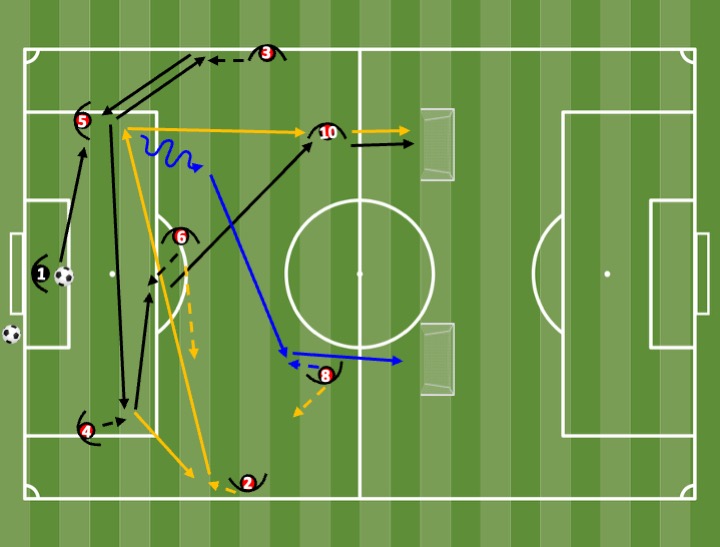
| Objective | Improve body positioning, control, passing and 3rd man |
| Players | 8-20 players |
| Materials | Cones, discs and balls |
| Space | Space of 12-25 metres |
| Duration | 2-4 sets x 4-6 min per set |
| Category | Collective technique |
The task consists of a passing circuit in which control, passing and third-man combinations are performed.
In the circuit follow the numerical rotation. One-touch play is required at key positions.
Focus on ball control, pass execution and the third-man combination.
Variation: reduce the space to increase defensive intensity or add a touch limit to force faster play. You can also add a joker to create numerical superiority and facilitate learning.
Passing circuit (3+2v2)
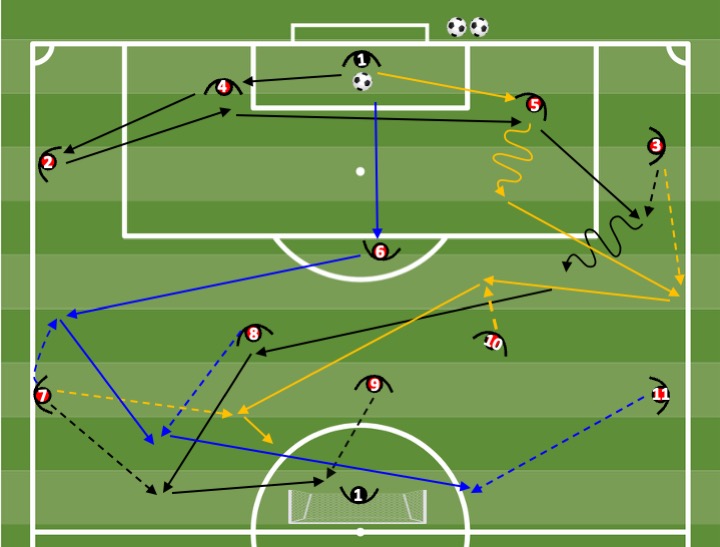
| Objective | Improve body positioning, control, passing and 3rd man |
| Players | 9-20 players |
| Materials | Cones, discs and balls |
| Space | Space of 12-25 metres |
| Duration | 2-4 sets x 4-6 min per set |
| Category | Collective technique |
The task consists of a passing circuit in which control, passing and third-man combinations are performed.
In the circuit follow the numerical rotation. One-touch play is required at key positions.
Focus on ball control, pass execution and the third-man combination.
Variation: reduce the space to increase defensive intensity or add a touch limit to force faster play. You can also add a joker to create numerical superiority and facilitate learning.
Build your full session with FutCoach
FutCoach generates complete training sessions for U14 players in seconds. Select your age group, the session objective (ball build-out) and the number of players, and the AI creates a complete session for you with warm-up, main block and cool-down. Download FutCoach free and prepare your next build-out session in less than 2 minutes. No blank templates, no improvising on the field.
Frequently asked questions
Why is it important to work on ball build-out from an early age?
Working on build-out at U14 (13-14 years) creates the automatisms the player will need throughout their career. Knowing how to offer passing lines, understand the moment to press forward and recognise the free teammate are skills that, worked on systematically, become an automatic competitive advantage.
What do I do when the opponent presses high and we cannot play out?
There must always be a direct ball option when the opponent's high press closes all short build-out options. The player must know how to read the situation and choose between short play (build-out) and the long ball (direct play). Training both solutions prevents the team from being blocked when facing intense pressing.
How many players take part in the ball build-out exercises?
"The most useful build-out exercises work with 6-14 players. Analytical passing circuits can be done from 4-5 players. The bigger exercises, simulating real build-out situations, need 8-12 players to recreate realistic scenarios for the players."
Related articles
Ball build-out exercises for U8 players
Knowing how to play the ball out from the back is one of the hallmarks of modern football teams. For U8 players (6-8 years), build...
Ball build-out exercises for U10 players
Knowing how to play the ball out from the back is one of the hallmarks of modern football teams. For U10 players (9-10 years), bui...
Ball build-out exercises for U12 players
Knowing how to play the ball out from the back is one of the hallmarks of modern football teams. For U12 players (11-12 years), bu...